


Safe Flooring for Sensory Play: A Childcare Guide
Table of Contents
- What You'll Need Before You Choose Safe Flooring for Sensory Play
- Types of Safe Flooring for Sensory Play: What Actually Works
- The Benefits of Memory Foam Playmats in Early Learning Rooms
- Easy-Clean Flooring for Early Learning: Hygiene Without the Headache
- NDIS Sensory Equipment Requirements: What Families Need to Know
- Step-by-Step: How to Choose and Install Your Sensory Play Flooring
- Common Mistakes When Choosing Safe Flooring for Sensory Play
- Frequently Asked Questions
Last Updated: October 4, 2026
What You'll Need Before You Choose Safe Flooring for Sensory Play
Safe flooring for sensory play is a cushioned, non-slip surface that protects children from falls while giving them the grip and comfort they need to move, sit and explore. Get it right and you've built the foundation of a calm, functional space. Get it wrong and you're replacing it within a year.
At Grace & Maggie, we supply childcare centres, early learning rooms and schools, and we've watched this decision play out in hundreds of spaces. Before you spend a cent, do these two things first.
Measure the space and map the zones
Pull out a tape measure and sketch your room. Then split it into zones:
- Active zone for crawling, rolling and tummy time
- Quiet zone for reading and calm-down time
- Transition zone near doors and shelving
A single large mat rarely suits a whole room. Most centres we work with use one thick mat in the active area and smaller pieces elsewhere.
Check your regulatory and funding position
The National Quality Framework sets the standards early learning services are assessed against, including requirements around safe, hygienic environments. Check your service's obligations before ordering.
If you're a family rather than a centre, check whether your funding covers the item. More on that below.
Types of Safe Flooring for Sensory Play: What Actually Works
Three material families do most of the heavy lifting in childcare and education settings: memory foam and tatami-style mats, cushioned vinyl, and rubber or carpet tiles. Each suits different rooms and budgets.
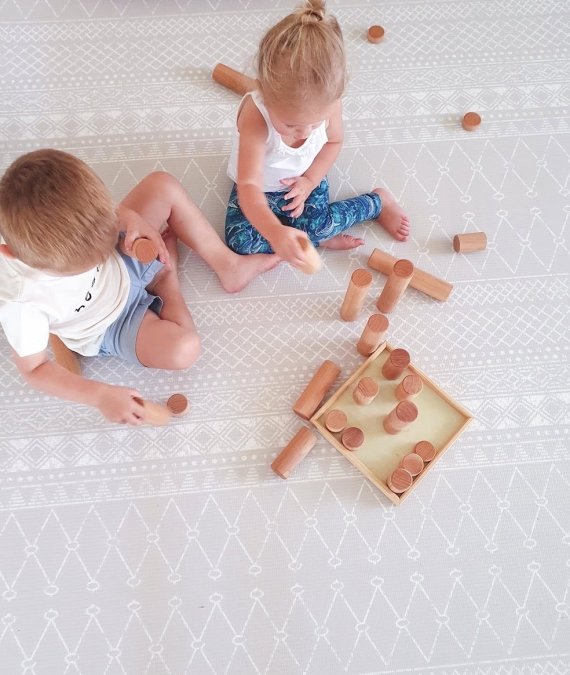
Memory foam and tatami-style mats
This is the option we'd pick for sensory rooms and floor play. High-density memory foam gives real cushioning without a bouncy, unstable feel, and the short-pile surface on a tatami-style mat cleans far more easily than a plush rug.
Our Snuggle Rugs use premium 35D high-density slow-rebound foam and expand to about 35mm thick. That density matters. A thicker, denser foam holds its shape under daily use instead of flattening into a pancake.

Cushioned vinyl, rubber and carpet tiles
These work well for wet areas, art zones and high-traffic corridors. Cushioned vinyl is the easiest to wipe down. Rubber tiles handle heavy foot traffic and won't slide. Carpet tiles soften noise but trap sand, paint and crumbs, so they suit quiet reading corners rather than messy play.
Here's the short version:
| Material | Best For | Cleaning Effort | Cushioning |
|---|---|---|---|
| Memory foam / tatami mat | Sensory rooms, floor play, tummy time | Wipe or vacuum | High |
| Cushioned vinyl | Art zones, wet areas, dining | Mop | Medium |
| Rubber tiles | Corridors, high traffic | Mop or sweep | Medium |
| Carpet tiles | Reading corners, quiet zones | Vacuum, spot clean | Low to medium |
The Benefits of Memory Foam Playmats in Early Learning Rooms
The main benefit of memory foam playmats is cushioning that holds up over years, not months. Cheap foam compresses within weeks and leaves you with a flat, useless mat. High-density foam springs back.
For educators, that translates into a few practical wins:
- Fewer bumps during crawling, rolling and rough-and-tumble play
- Comfort for adults sitting on the floor during group time
- Quieter rooms, because foam absorbs sound better than hard flooring
- A defined space children learn to associate with calm-down and quiet time
Density is the number to check. Foam rated 35D is roughly double the density of many similar mats on the market, which is why it stays supportive instead of collapsing.
Easy-Clean Flooring for Early Learning: Hygiene Without the Headache
Easy-clean flooring for early learning comes down to one thing: a sealed surface with no deep fibres for mess to hide in. If you can wipe it with a damp cloth and a mild cleaner, you've got the right product.
Sensory play gets messy. Sand, paint, playdough, food, and the occasional accident all end up on the floor. Long-pile rugs are the worst offenders because liquid soaks straight into the base.
A short-pile tatami-style surface solves this. Wipe spills as they happen, vacuum regularly, and spot clean with a mild detergent. Skip harsh chemicals, which can break down the coating over time.
For centres, build cleaning into the daily routine rather than treating it as a weekly job. A two-minute wipe at pack-up time beats an hour of scrubbing on Friday.
NDIS Sensory Equipment Requirements: What Families Need to Know
NDIS sensory equipment requirements vary by plan, but the core rule is simple: the item must be reasonable and necessary and directly linked to the participant's disability support needs. A sensory mat can qualify when it's tied to a specific goal in your plan.
The NDIS guidelines on reasonable and necessary supports set out how this works. Funding can come through your plan's core or capacity building budgets, depending on how the support is classified. Talk to your plan manager or support coordinator before you buy.
The practical part: keep your receipts and a short note explaining how the item supports your child's goals. If you're buying from a registered provider, the process is simpler because the invoice meets NDIS requirements from the start.
Grace & Maggie is a registered NDIS provider, so families and coordinators can claim our products without chasing extra paperwork.
Step-by-Step: How to Choose and Install Your Sensory Play Flooring
Choosing and installing safe flooring for sensory play takes about a week from measurement to finished space. Here's the process we'd follow.
Total time: 3 to 7 days Difficulty: Beginner
What you'll need:
- Tape measure and floor plan sketch
- Your service's safety and hygiene policy
- A sample or two of shortlisted materials
- Non-slip underlay if your floor is smooth and hard
Step 1: Measure the zone, not the room. Mark the area you actually need covered. Leave clearance around doors and fixed furniture.
Step 2: Check the surface underneath. Tiles and timber need a non-slip layer if the mat could shift. Carpet usually grips on its own.
Step 3: Order a sample first. Colour and texture look different in your room's light than on a screen.
Step 4: Unroll and let it settle. Give memory foam 24 to 48 hours to expand and flatten fully.
Step 5: Trim or position around fixed points. Keep the mat clear of heaters and power points.
Step 6: Test it underfoot. Walk on it, kneel on it, and check the edges don't curl where children run.
Step 7: Set your cleaning routine. Wipe daily, vacuum weekly, spot clean as needed.
Expected result: a stable, cushioned surface that stays put and wipes clean in minutes.
Common Mistakes When Choosing Safe Flooring for Sensory Play
The biggest mistake is buying on price and thickness alone. A cheap 20mm mat sounds generous until it flattens in a term. Density beats depth every time.
A few more we see often:
- Ignoring the slip risk. A soft mat on a smooth floor can slide. Check grip before you commit.
- Choosing plush over practical. Deep fibres look lovely and clean terribly.
- Skipping the sample. Colours shift dramatically between a screen and a sunlit room.
- Forgetting storage. Stackable mats beat one giant piece in shared rooms.
- Overlooking wheelchair access. If a child uses a wheelchair, you need a firm, grippy surface, not a deep soft one that traps wheels.
That last point matters where many centres run mixed-age and mixed-ability rooms. If you're searching for sensory play flooring near me, ask whether the product suits both floor play and mobility equipment before you order.
Choosing flooring for a sensory space is a real decision with real consequences. Get it wrong and you're dealing with slips, stains and replacements mid-year. Get it right and the space just works, quietly, every day.
Grace & Maggie builds products for exactly this job. Our Snuggle Rugs use 35D high-density memory foam at roughly 35mm thick, our TPU Padded Playmats are free from BPA and PVC, and our Cove Sensory Lounger gives children a seating option that moves the way they do. We're a registered NDIS provider, and our range is designed in Australia for childcare and education settings.
Get started with Grace & Maggie and build a sensory space that holds up to everything a room full of children throws at it.
Frequently Asked Questions
What are the safety standards for sensory play flooring in Australian childcare centres?
In Australia, childcare flooring must meet the National Construction Code and Australian Standards for impact attenuation and slip resistance, and fall height requirements under the Education and Care Services National Regulations. For sensory play, look for products that are free from BPA and PVC and carry clear material disclosures. Ask suppliers for documentation before purchase, and check that any mat or rug you add on top of existing flooring does not create a trip hazard or block emergency exits.
How do I choose non-toxic flooring for sensory play?
Start with the material list, not the marketing. Products made from TPU-coated memory foam and free from BPA and PVC are a practical choice for early learning spaces where children sit, crawl and lie on the floor. Avoid strong chemical odours out of the packaging, ask for material safety documentation, and air new mats in a well-ventilated room before use. If a child in your care has chemical sensitivities, confirm the exact composition with the supplier in writing.
Are there NDIS-approved flooring options for sensory rooms?
The NDIS does not publish a list of approved flooring products. Instead, funding depends on whether the item is considered reasonable and necessary for the participant's goals and is supported by an occupational therapist's recommendation. Grace & Maggie is a registered NDIS provider, so families can purchase sensory mats and rugs through their plan where the therapist supports the need. Keep your OT report and receipts for your plan manager or self-management records.
How do I keep sensory play flooring hygienic in a busy classroom?
Choose a short-pile or coated surface that can be wiped or vacuumed daily rather than deep-cleaned weekly. Spot-clean spills immediately with a mild detergent and water, vacuum high-traffic areas each day, and rotate or air mats regularly. For memory foam rugs, follow the manufacturer's cleaning instructions and avoid soaking the foam core. A cleaning roster that names who checks the floor each session keeps hygiene consistent across a busy early learning day.