

How to Choose Non-Toxic Playmats for Every Room
Last Updated: November 19, 2026
Quick Summary
The best non-toxic playmats for every room are chosen by matching the mat to each room's job: a round 140cm mat for the nursery, a large 200cm x 140cm rectangle for the living room or playroom, and a Snuggle Rug for a sensory corner. Look for certified foam and fabric with no PVC, BPA or phthalates.
- Measure the clear floor area between furniture and keep at least a 60cm walkway before sizing up.
- CertiPUR-US covers foam and OEKO-TEX STANDARD 100 covers fabric, so ask for the certificate name.
- Our Padded Playmats use TPU-coated memory foam free from BPA and PVC.
- A stated nonslip base helps keep Snuggle Rugs in place on polished timber and tiles.
- Avoid machine washing or soaking a foam mat, as full immersion can damage the foam core.
Table of Contents
- Start With How Each Room Is Actually Used
- Safe Playmat Materials for Babies and What the Certifications Mean
- Matching Mat Size and Shape to Room Layout
- Padded Playmats for Childcare and Education Settings
- Easy-Clean Play Mats for Toddlers in High-Traffic Rooms
- Play Mats for Early Learning Environments and Sensory Spaces
- Grip, Slip Resistance and Use Beyond Infancy
- Choosing Your Non-Toxic Playmats Room by Room
- Frequently Asked Questions
Start With How Each Room Is Actually Used
The best non-toxic playmats are chosen room by room, not bought once and dragged around the house. A nursery mat needs cushioning for tummy time. A living room mat needs to look like furniture. A playroom mat needs grip for running toddlers.
We're Grace & Maggie, and we make padded playmats and sensory rugs for Australian homes and early learning rooms. A single mat rarely suits every room of a house.
Below, we'll walk you through safe playmat materials for babies, what certifications actually mean, and how to size a mat for every space from a Langwarrin nursery to a classroom corner. We'll also cover padded playmats for childcare settings, because the same rules apply whether the room is at home or in an early learning centre.
The core idea is simple. Match the mat to the room's job. A mat that's perfect for a calm nursery may be wrong for a hallway, and a mat built for a busy playroom may be overkill beside your bed.
Safe Playmat Materials for Babies and What the Certifications Mean
Safe playmat materials for babies are those with a documented, testable safety story: certified foam, a certified fabric, and no PVC, BPA or phthalates in the build. Certification matters more than marketing language.
So what do the labels mean? Certifications such as CertiPUR-US (foam) and OEKO-TEX STANDARD 100 (fabric) are third-party programs, so check that a maker names the specific certificate rather than relying on vague claims like "non-toxic".
For Australian buyers, the ACCC product safety guidance is worth knowing, since it explains how consumer products are regulated here and what to do if something fails. Watch out: "eco-friendly" and "non-toxic" printed on a box are not certifications. Ask for the certificate name.
Foam, TPU and Vegan Leather: What Each One Suits
Foam suits cushioning: it's what makes a mat soft enough for crawling and rolling. TPU, a flexible polyurethane coating, suits an easy-clean surface on top of that foam, which is why our Padded Playmats use a TPU-coated memory foam build that's free from BPA and PVC. Vegan leather suits portability: The Wanderer is made from vegan leather and folds into a tote for park trips.
If you're weighing materials directly, our guide to TPU padded play mats versus memory foam snuggle rugs breaks down the trade-offs.
Matching Mat Size and Shape to Room Layout
Mat size should follow the room's clear floor area, not the room's total size. Measure the space between furniture, subtract door swings, then choose the largest mat that fits with a walkway left over.
A simple planning table helps:
| Room | Typical mat shape | What it needs to do |
|---|---|---|
| Nursery | Round, 140cm diameter | Base for a play gym, tummy time |
| Living room | Large rectangle, 200cm x 140cm | Blend with furniture, cushion hard floors |
| Playroom | Large rectangle | Room for siblings and toys |
| Small apartment corner | Small rectangle, 140cm x 100cm | Fit without blocking walkways |
| Reading or calm corner | Snuggle Rug | Soft, quiet, sensory-friendly |
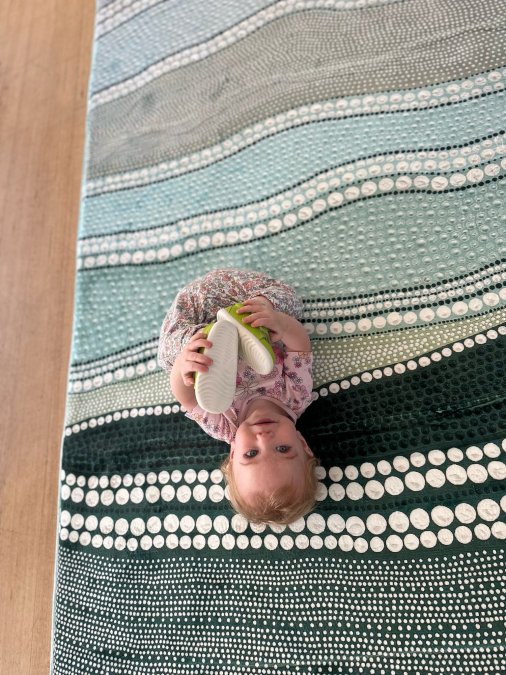
For childcare and education settings, the same measuring logic applies. Group floor-play zones generally suit a larger mat such as the 200cm x 140cm Large Padded Playmat, so children have room to sit, roll and reach toys. A quiet reading or calm-down corner can work with a round 140cm mat or a Snuggle Rug, because the goal there is a defined, soft boundary rather than maximum coverage. Measure the distance from the mat edge to the nearest shelving, door and thoroughfare, and check that the mat will not overlap a doorway swing or block an educator's line of sight across the room.
Shape matters as much as size. Rectangles suit rooms with straight furniture lines and group activities; rounds soften corners and work well as a base for play gyms or in rooms where children move around the mat rather than across it. In rooms with fixed furniture, mark the proposed mat footprint on the floor with painter's tape before buying, then walk the route children will take. If the tape leaves less than a 60cm walkway, size down.
Our playmat size guide walks through measuring and choosing with confidence.
Padded Playmats for Childcare and Education Settings
Padded playmats for childcare settings are chosen for daily use, easy cleaning between sessions, and enough coverage for group activities.
Our TPU Padded Playmats offer a soft, supportive surface and are free from BPA and PVC, making them a practical choice for early learning spaces. The large 200cm x 140cm size suits group floor play, while the round 140cm version works as a base for play gyms and quieter corners.
For providers planning sensory-friendly rooms, our guide to safe flooring for sensory needs in childcare goes deeper into matching surfaces to children's needs.
Easy-Clean Play Mats for Toddlers in High-Traffic Rooms
Easy-clean play mats for toddlers are the ones with a sealed, wipeable surface, because high-traffic rooms punish fabric. Spills, paint, crackers, nappy accidents: the mat needs to handle all of it without soaking.
Our Snuggle Rugs have a short-pile surface that is practical for everyday family, education and sensory spaces.
Watch out: avoid machine washing or soaking a foam mat, as full immersion can damage the foam core. Our playmat cleaning guide covers the full routine.
Play Mats for Early Learning Environments and Sensory Spaces
Play mats for early learning environments do double duty: they cushion, and they define zones. A mat signals "this is where we read" or "this is the calm corner", which helps children self-regulate.
Sensory spaces benefit most from a soft, supportive surface with a low-pile finish. Our Sensory Tatami Snuggle Rugs use 35D high-density slow-rebound foam, expanding to 35mm thick, with a short-pile surface. The Dennis and Archer Earth designs suit reading corners and quiet spaces.
For movement and seating in these rooms, our adjustable Cove Sensory Lounger supports the way children naturally sit and rock.
Grip, Slip Resistance and Use Beyond Infancy
Grip matters more than most parents expect, and it matters well past the baby stage. A mat that slides on hardwood or tiles is a hazard for crawlers, toddlers, and children using mobility aids. In childcare and education rooms, the risk is higher again because several children may be moving across the mat at once, and an educator may not see a slow slide until the mat has shifted against a wall or shelf.
Look for a nonslip base as a stated feature, not an assumption. Snuggle Rugs are listed with a nonslip base, which helps keep the rug in place during play. On hard floors, the mechanism is friction between the base and the floor: a textured or high-friction underside resists lateral movement, while a smooth base on polished tiles or timber can creep over time. On carpet, the opposite can happen, because a very grippy base may bunch the carpet underneath; check that the mat sits flat without ridges before use.
Floor type changes the advice. Polished timber and tiles are the most demanding surfaces, so prioritise a mat with a stated nonslip base and test it by placing the mat down and giving it a firm sideways push with your foot before children use it. Low-pile carpet and vinyl are more forgiving, but still check that the mat does not curl at the edges, because a lifted edge is a trip point. In early learning rooms, avoid placing a mat directly against a doorway or across a thoroughfare where children run; even a well-gripped mat can shift under repeated fast turns.
Watch out: a mat that slides on a hard floor should be secured or replaced before children use it, because a moving surface under a crawling baby is a fall risk.
Beyond infancy, the same mats keep earning their place: yoga and stretching, reading on the floor, sibling wrestling, even a comfortable base for at-home workouts. In education settings, a gripped mat also supports seated group work, story time and sensory regulation, because children can sit and move without the surface shifting beneath them. If grip is your main concern, our guide to non-slip mats for toddlers covers what to look for.
Choosing Your Non-Toxic Playmats Room by Room
Choosing non-toxic playmats room by room is the fastest way to get this right. Here's how we'd do it in a Langwarrin home, and it works the same way in a VIC early learning centre.
- Nursery: a round mat, 140cm diameter, as a play gym base.
- Living room: a large reversible rectangle that looks like a rug, such as Baby Driver / Boho at 200cm x 140cm.
- Playroom: a large mat with room for siblings and toys.
- Small apartment: the small 140cm x 100cm Forrest / Blush mat fits without blocking walkways.
- Sensory corner: a Snuggle Rug for quiet, cushioned floor time.
- Outdoors and outings: The Wanderer vegan leather mat, which folds into its own tote.
You can shop our range online, or contact us about visiting our Langwarrin store.
Our Snuggle Rugs arrive vacuum-sealed and may take a few days to fully expand, with some creases taking longer to relax.
Every room in your home asks something different of a playmat, and picking one mat for the whole house usually means compromising somewhere. At Grace & Maggie, we build padded playmats, Snuggle Rugs and the Cove Sensory Lounger for exactly this problem: TPU-coated memory foam free from BPA and PVC, certified materials, and designs that suit a nursery as well as a classroom. We're a registered NDIS provider and a 2025 Bounty Award winner, and we'd love to help you fit out every room properly. Get started with Grace & Maggie and give each space the surface it actually needs.
Frequently Asked Questions
What should I look for in non-toxic playmats?
Check what the mat is made from and which certifications the maker lists. Foam mats should carry CertiPUR-US certification, and fabrics are often OEKO-TEX STANDARD 100 tested. Look for BPA-free and PVC-free claims stated on the listing rather than assumed, and ask how the mat is finished so you know whether off-gassing or odour is likely on arrival. Thickness, size and grip matter just as much as chemistry, so match those to the room before you buy.
Which playmat material suits a playroom versus a living room?
A playroom usually wants depth and coverage, so a 35mm memory foam snuggle rug or a large padded playmat works well for crawling and tumble play. A living room often needs something that looks like part of the furniture, so a reversible padded playmat with a neutral side or a round mat under a play gym blends in better. For outdoor or transitional spaces, a foldable vegan leather mat is lighter and wipes clean quickly.
Are padded playmats easy to clean in childcare settings?
Padded playmats with a TPU or coated surface wipe clean with a damp cloth and mild soapy water, which suits the spill and mess cycle of a childcare room. Memory foam snuggle rugs should not be machine washed or soaked, because full immersion can damage the foam.
How do I keep a playmat hygienic across a whole home?
Avoid harsh chemicals and abrasive scrubbers, which can damage coated surfaces over time.
