

Best Non-Slip Mats for Toddlers: 2026 Playmat Guide
Table of Contents
- What Makes a Non-Slip Mat Safe for Toddlers
- Quick Comparison: Best Non-Slip Mats for Toddlers
- 1. Forrest / Blush Padded Playmat: Best for Blended Living Spaces
- 2. Archer Earth Snuggle Rug: Best for Sensory Play and Tummy Time
- 3. Baby Driver / Boho Padded Playmat: Best for Imaginative Play
- 4. The Wanderer Vegan Leather Mat: Best for Indoor and Outdoor Use
- 5. The Streets / Mod Jute Padded Playmat: Best for High-Traffic Playrooms
- 6. Checkmate Denim / The Streets Padded Playmat: Best for Shared Spaces
- How to Clean TPU Playmats and Keep Them Mould-Free
- Frequently Asked Questions
Last Updated: September 25, 2026
What Makes a Non-Slip Mat Safe for Toddlers
A safe non-slip mat for toddlers combines a grippy base, a cushioned surface and materials free from harmful chemicals. Get those three right and you've solved the two problems parents complain about most: mats that slide across wet tiles, and mats that grow mould underneath.
At Grace & Maggie, we've designed playmats for this stage, addressing common parent concerns about movement and maintenance.
Here's the thing most buying guides skip: a mat that grips the floor and a mat that cushions a fall are two different engineering problems. You need both.
Slip-Resistant Bases and Surface Texture
A slip-resistant base is a textured underside that grips the floor through friction rather than adhesion. It doesn't need suction cups or sticky coatings. It needs a dense, rubberised texture that presses into the floor surface and resists lateral movement.
This matters more than most parents realise. A mat that creeps 10cm every time a toddler launches off it will eventually end up against a wall or a heater. The fix is simple: look for a nonslip base described as a designed or branded underside, not just "anti-slip" in the marketing copy.
Surface texture matters too. A short-pile or smooth coated surface lets small feet pivot without catching. Long fibres are the opposite: they catch toes and turn a stumble into a fall.
Cushioning, Height and Fall Absorption
Cushioning is measured in foam density and thickness, and it's what absorbs the impact when a toddler topples. A 35mm mat made from 35D high-density slow-rebound foam will absorb far more than a 10mm decorative rug.
Density is the number most brands hide. A higher D rating means more foam per cubic centimetre, which means the mat keeps its shape instead of flattening into a permanent dent under the couch.
Beyond the structural integrity of the base, the surface material should remain gentle against sensitive skin, which is why selecting appropriate soft toddler fabrics is essential for creating a truly comfortable environment.
Quick Comparison: Best Non-Slip Mats for Toddlers
Product |
Price |
Thickness |
Best For |
Surface |
|---|---|---|---|---|
$219.00 |
1.5cm |
Blended living spaces |
Double-sided coated foam |
|
Archer Earth Snuggle Rug |
$149.00 |
3.5cm |
Sensory play and tummy time |
Short-pile memory foam |
Baby Driver / Boho Padded Playmat |
$219.00 |
1.5cm |
Imaginative play |
Double-sided coated foam |
The Wanderer Vegan Leather Mat |
$149.00 |
2mm |
Indoor and outdoor use |
Vegan leather |
The Streets / Mod Jute Padded Playmat |
$219.00 |
1.5cm |
High-traffic playrooms |
Double-sided coated foam |
Checkmate Denim / The Streets Playmat |
$219.00 |
1.5cm |
Shared spaces |
Double-sided coated foam |
All six are made from non-toxic materials free from BPA and PVC, and all wipe clean with a damp cloth.

1. Forrest / Blush Padded Playmat: Best for Blended Living Spaces
The Forrest / Blush is the mat you buy when you don't want a playmat to look like a playmat. One side is a soft geometric design in pastel pink; the other carries a trademark print that sits quietly in a styled room.
At roughly 200cm x 140cm x 1.5cm, it's big enough for two toddlers and a parent. The multi-use design doubles as a base for tummy time or at-home workouts, which is why it tends to stay out rather than get rolled away.
Where it falls short: 1.5cm of foam won't absorb a hard fall the way a 35mm memory foam rug will. If your toddler is in full climbing mode, pair it with a thicker option.
2. Archer Earth Snuggle Rug: Best for Sensory Play and Tummy Time
Archer Earth is the thickest option here at 35mm, made from premium 35D high-density slow-rebound foam. That's roughly double the density of many similar rugs, and you feel the difference the moment you kneel on it.

The design is a muted, distressed arch pattern in stone, clay and sand tones. It suits neutral interiors and doesn't scream "children's product," which matters if the mat lives in your living room.
This is the one I'd point sensory-seeking families toward. The cushioned surface gives a soft landing for crawling, rolling and sitting, and the short pile keeps allergens down compared with traditional plush rugs. It's also a strong fit for families accessing NDIS funding, since Grace & Maggie is a registered NDIS provider.
Where it falls short: It arrives vacuum-sealed and needs 48 to 72 hours to fully expand. Stubborn creases can take several days to relax.
Forrest / Blush - Padded Playmat - Large →
3. Baby Driver / Boho Padded Playmat: Best for Imaginative Play
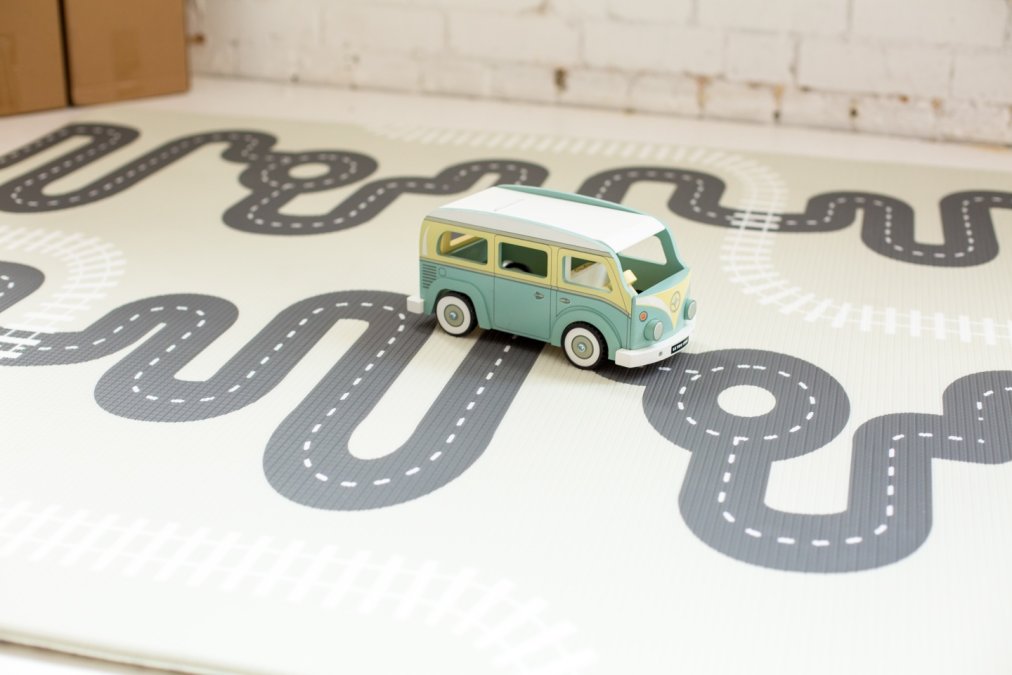
Baby Driver features a minimal track design built for toy cars and train sets on one side, and a neutral boho print in off-white and cream on the other.

The track side is the drawcard. It gives toddlers a structured surface for pretend play, which keeps them engaged longer than a plain mat. The reverse side is neutral enough to leave out when the toys go away.
At 200cm x 140cm x 1.5cm, it's the same footprint as the Forrest and the Streets. The surface is waterproof, so spills wipe up rather than soak in.
Where it falls short: The track design is a strong visual commitment.
4. The Wanderer Vegan Leather Mat: Best for Indoor and Outdoor Use
The Wanderer is the odd one out, and that's the point. It's made from non-toxic vegan leather, measures 2000mm x 1300mm x 2mm, and folds into a canvas tote bag.
5. The Streets / Mod Jute Padded Playmat: Best for High-Traffic Playrooms
The Streets side is a textured road and train track design in neutral brown jute tones. The Mod side is abstract art on a nude base with peach undertones. Both work in a busy playroom.
6. Checkmate Denim / The Streets Padded Playmat: Best for Shared Spaces
Checkmate Denim pairs a distressed blue checkered print with the Streets track design on the reverse. It's the most design-forward option in the range, and it's built for rooms where kids and adults share the floor.
How to Clean TPU Playmats and Keep Them Mould-Free
Cleaning a TPU playmat takes about two minutes: wipe with a damp cloth or gentle baby wipe, then let it air dry completely before use. The mistake most parents make is putting it away damp.
- Wipe spills immediately with a damp cloth and mild soapy water
- Vacuum weekly to lift dust from the surface texture
- Spot clean stains with mild detergent and a soft cloth
- Never use bleach, abrasive cleaners or harsh chemicals
- Air dry fully on both sides before storing or flipping
- Keep out of direct sunlight and away from heat sources
- Check underneath monthly for trapped moisture
Durable Playmats vs Standard Rugs for High-Traffic Areas
A standard rug is built for feet in socks. A durable playmat is built for knees, elbows, toy cars and juice. The difference comes down to three things: a waterproof or water-resistant surface, a foam core that rebounds instead of flattening, and a nonslip base that holds position.
Compatibility with Textured Bathtubs and Tiled Floors
Smooth tiles and polished floorboards give a nonslip base the best grip. Textured surfaces are trickier. Deep grout lines and rough tiles reduce the contact area between the mat and the floor, which weakens the hold.
Long-Term Durability and Disposal
Density contributes to a mat's longevity. A 35D foam core is designed to hold its shape through daily use.
Frequently Asked Questions
What features should I look for in a non-slip mat for toddlers?
Prioritise a slip-resistant base that grips smooth floors, a cushioned surface to absorb falls, and non-toxic materials such as TPU. Look for BPA-free and PVC-free construction, a waterproof or water-resistant top for easy cleaning, and a size that covers your play area.
Are TPU-coated memory foam mats safer than standard rubber mats?
TPU-coated memory foam mats are generally free from BPA, PVC and latex. For toddlers with sensitive skin or allergies, a non-toxic TPU mat with a cushioned foam core offers both slip resistance and impact absorption without harsh chemicals.
How do I clean and maintain a non-slip mat so it stays effective?
Vacuum or wipe the surface weekly with a damp cloth and mild soapy water. For TPU playmats, spot clean stains with a mild detergent and avoid bleach or abrasive scrubbers. Dry the mat fully before use.
Can a non-slip mat help prevent slips and falls in the bathroom?
Yes. A non-slip bath mat with suction cups or a textured rubber base reduces the risk of slipping on wet tiles. Look for drain holes to prevent water pooling and mould, and choose a size that covers the main standing area. Always follow the manufacturer's weight and age guidance, and never leave a toddler unattended in the bath.
What is the difference between a play mat and a bath mat for toddlers?
A play mat is designed for dry floor areas, offering cushioning, insulation and a slip-resistant base for crawling, sitting and tummy time.