

How to Choose Non Toxic Nursery Decor for Safer Spaces
Last Updated: November 15, 2026
Quick Summary
To choose non toxic nursery decor, look for formaldehyde-free timbers, low-VOC or non-toxic paint, phthalate-free plastics and natural fibres, and check every surface, not just the cot. For a non toxic nursery, confirm products are free from BPA and PVC where relevant and ask suppliers which standards a product is tested to.
- Indoor air quality matters more in children's spaces because young lungs are still developing.
- Check the rug, shelving and wall decals, not only the cot.
- Ask suppliers directly whether cots, change tables and shelving meet current Australian standards.
- Anchor every shelving unit and change table to the wall in shared care rooms.
- Check certifications such as OEKO-TEX or GOTS by certificate number and scope, not a logo alone.
Table of Contents
- Understanding VOCs and Indoor Air Quality in Children's Spaces
- The Benefits of BPA Free Nursery Products for Growing Children
- Choosing Non-Toxic Playmats for Daycare and Early Learning
- Safe Nursery Furniture Standards Australia Parents Should Know
- A Checklist for Sourcing Non Toxic Nursery Decor Locally
- Budget-Friendly DIY and Second-Hand Safety for Nursery Decor
- Creating a Healthier Space with Grace & Maggie
- Frequently Asked Questions
Understanding VOCs and Indoor Air Quality in Children's Spaces
Volatile organic compounds are the invisible guests in a new nursery. These chemicals, known as VOCs, can off-gas from paints, glues, foams and treated fabrics, and linger in indoor air. Indoor air quality matters more in children's spaces because young lungs are still developing and children spend long stretches close to the floor.
When we talk about non toxic nursery decor, we mean furnishings and finishes chosen to keep chemical exposure low: formaldehyde-free timbers, low-VOC and non-toxic paint, phthalate-free plastics and natural fibres. Off-gassing is the process where these compounds release into the air over time, which is why a room can smell "new" for weeks.
A common mistake is focusing only on the cot and forgetting the rug, the shelving and the wall decals. Every surface contributes. Ventilation helps, but it does not replace choosing materials carefully in the first place. For childcare and education settings, where many children share one room for hours, that principle scales up fast.
The Benefits of BPA Free Nursery Products for Growing Children
BPA free nursery products reduce one well-known chemical of concern from a child's everyday environment. Bisphenol A is used in some hard plastics, and because babies and toddlers mouth, chew and crawl across surfaces constantly, parents increasingly look for BPA-free and PVC-free materials as a baseline.
The practical benefits of BPA free nursery products go beyond the label.
A common mistake is assuming "BPA free" alone means a product is fully safe. Check the whole material story: what the foam is, what coats it, and whether the brand avoids PVC and fire retardants where possible. For early learning spaces, a mat that is BPA and PVC free, wipeable, and thick enough to cushion falls during active play is a sensible choice.
Choosing Non-Toxic Playmats for Daycare and Early Learning
Non-toxic playmats for daycare need to do two jobs at once: protect children from hard floors and avoid introducing avoidable chemicals into a room used all day. The best choice combines a safe material, a supportive thickness and a surface that wipes clean between sessions.
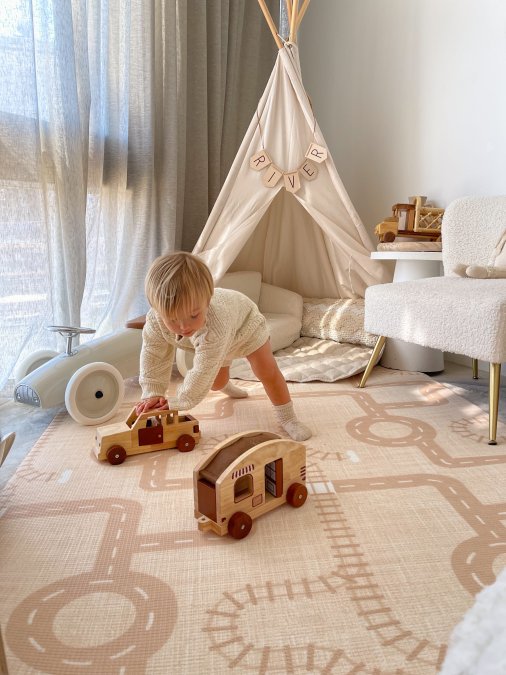
Material is the first filter. Look for TPU or similarly specified coatings rather than polyvinyl chloride, and confirm the mat is free from BPA and PVC. Thickness and density decide comfort and durability under constant use. A low-VOC, hypoallergenic surface with a non-slip base also suits children with sensory processing needs and those using mobility aids.
This is where our own range fits naturally. Our padded playmats use high-quality TPU-coated memory foam, are free from BPA and PVC, and are designed for high-use early learning spaces. If you are fitting out a centre, you can browse our non-toxic padded play mats, read our guide to playmats for schools, daycare and community groups, or go deeper with safe flooring for sensory needs.
Safe Nursery Furniture Standards Australia Parents Should Know
Safe nursery furniture standards in Australia are guided by mandatory cots and voluntary furniture standards, and the safest approach is to check a product's compliance before you buy. Rather than memorising clause numbers, ask suppliers directly whether their cots, change tables and shelving meet the current Australian standards for that product type.
Beyond the standard itself, material choice drives nursery safety. Formaldehyde-free timbers, non-toxic paint and low-VOC finishes reduce indoor air pollution in a small, often poorly ventilated room. Stable, well-anchored furniture also prevents tip-over injuries once a toddler starts climbing, in shared care rooms, anchor every shelving unit and change table to the wall, not just the tall pieces.
A common mistake is buying second-hand furniture without checking for recalls or missing fixings. Before you assemble a room, it helps to work from a full baby room essentials checklist for Australian parents so the safety checks apply across the whole space, not just the cot.
| Item | What to check | Why it matters |
|---|---|---|
| Cot | ACCC mandatory standard (based on AS/NZS 2172), firm mattress fit | Prevents gaps and entrapment |
| Change table | Stability, safety strap, raised edges, wall anchor | Reduces fall risk |
| Shelving | Wall-anchored, no tipping | Stops tip-over injuries |
| Bunk beds | AS/NZS 4220 where relevant | Guards and ladder safety |
| Finishes | Low-VOC, formaldehyde-free | Better indoor air quality |
A Checklist for Sourcing Non Toxic Nursery Decor Locally
Sourcing locally makes it easier to ask questions and verify claims. Before any item earns a place in a nursery or classroom, it helps to run it through a short checklist.
- Material listed clearly (TPU, organic cotton, solid timber, natural fibres)
- Free from BPA, PVC and added formaldehyde where relevant
- Low-VOC or non-toxic paint and non-toxic adhesives
- Certifications named, such as OEKO-TEX or GOTS for textiles
- Fire retardants and synthetic backing disclosed
- Supplier can explain ethical manufacturing and sustainability claims
- Easy to clean and breathable for shared spaces
When sourcing, it helps to ask suppliers which standard a product is tested to and whether the test report comes from an accredited laboratory. Certifications such as OEKO-TEX or GOTS are worth checking by certificate number and scope rather than a logo alone. For paints and finishes, look for a stated VOC content rather than a vague 'eco' label.
Where possible, visiting a showroom lets you smell, touch and inspect a product before you commit, checking seams and backing and confirming that a mat or rug is genuinely wipeable. For childcare and education settings, ask for the maintenance instructions and the expected lifespan under daily use, a product that needs replacing every year is not the sustainable choice, however green the label.
If you are planning a whole room, our eco-friendly nursery floor ideas help you finish the non-toxic decor plan once the checklist items are ticked off.
Budget-Friendly DIY and Second-Hand Safety for Nursery Decor
A tight budget does not have to mean compromising on a healthy home environment. Some of the safest choices are also the cheapest: fewer items, natural materials and a good clean.
DIY decor works well when you keep it simple. Choose non-toxic paint and low-VOC sealers for upcycled furniture, sand and air items before they come indoors, and favour natural dyes and upcycled materials over heavily treated finishes. A washable cotton throw or a simple timber shelf often beats a cheaper, chemically finished alternative.
Second-hand finds need a safety pass. Check for recalls, loose fixings, chipped paint and lingering chemical smells, and give anything soft a proper clean before use. Watch out: a strong "new" smell on second-hand foam or particleboard usually signals ongoing off-gassing, so let it air out thoroughly or pass on it.
Creating a Healthier Space with Grace & Maggie
Grace & Maggie creates products for childcare and education settings. A healthier room starts with the surfaces children actually touch, and our range is designed with exactly that in mind.
Our TPU padded playmats are free from BPA and PVC and built for high-use early learning spaces. Our memory foam Snuggle Rugs, including designs created with Australian artist Studio Dennis, add cushioned comfort for floor play, reading corners and calm-down zones. The Cove Sensory Lounger is designed to support the way children naturally move, sit and relax, and suits sensory spaces and breakout areas.
If you are setting up a nursery at home or refreshing a classroom, we are here to help you choose well. As a registered NDIS provider, we support families and providers looking for sensory-friendly flooring.
The challenge is simple: most rooms are furnished for looks first and safety second. Flip that order. Start with materials you can verify, then build the style around them. Grace & Maggie makes that easier with BPA and PVC free padded playmats, plush memory foam Snuggle Rugs and the adjustable Cove Sensory Lounger, all designed for childcare and education spaces. Get started with Grace & Maggie and create a safer, softer space children love to play in.
Frequently Asked Questions
What materials should I avoid in nursery decor to ensure a non-toxic environment?
Avoid items made with polyvinyl chloride (PVC), which can contain phthalates, and look out for furniture or textiles treated with fire retardants. Also be cautious with synthetic backing on rugs and any products with strong chemical odours, as these often indicate volatile organic compounds (VOCs) and off-gassing. Choosing products labelled formaldehyde-free and phthalate-free is a practical first step.
Are TPU playmats considered non-toxic for daycare settings?
TPU, or thermoplastic polyurethane, is generally considered a safer alternative to PVC for playmats. It is often free from BPA and phthalates, making it a preferred choice for non-toxic playmats for daycare. When selecting a mat, look for clear material descriptions and avoid those with a strong plastic smell. A high-quality TPU mat provides a durable, easy-to-clean surface for busy play areas.
How do I identify non-toxic nursery furniture and decor in Australia?
Start by looking for certifications like OEKO-TEX for textiles or GOTS for organic cotton, which verify safe processing. For furniture, check for formaldehyde-free glues and low-VOC finishes. Ask suppliers which safety standards their cots and change tables meet. Asking suppliers directly about materials and finishes is a reliable way to confirm what is in a product.
What are the benefits of BPA-free nursery products for infants?
BPA is an industrial chemical used in some plastics, and choosing BPA-free products reduces a child's potential exposure to it. For items like playmats and feeding products, BPA-free materials offer peace of mind, especially for infants who spend a lot of time on the floor and explore with their mouths. These products support a healthier indoor environment by avoiding a known endocrine-disrupting chemical.
