

Eco Friendly Nursery Floor Ideas for a Safe 2026 Space
Table of Contents
- What Makes a Nursery Floor Eco Friendly and Safe?
- Top Eco Friendly Nursery Flooring Materials Compared
- Why Choose Non Toxic Playmats for Babies?
- The Best BPA and PVC Free Playmats for Play Areas
- Selecting Safe Nursery Flooring Materials for Every Room
- Installation, Maintenance, and End-of-Life Considerations
- Conclusion: Create a Healthy Floor for Your Little One
- Frequently Asked Questions
Last Updated: September 9, 2026
Choosing the right eco friendly nursery floor ideas starts with one question: what is your baby actually touching, breathing, and putting in their mouth? Conventional flooring and playmats can release volatile organic compounds (VOCs) and contain chemicals linked to respiratory irritation. At Grace & Maggie, we have spent years designing safe play surfaces for Australian families, and the short answer is this: the best eco friendly nursery floor combines a hard-wearing natural base material with a soft, non-toxic playmat on top.
An eco friendly nursery floor supports healthy indoor air quality, comes from renewable resources, and avoids harmful chemicals like formaldehyde, BPA, and PVC throughout its life. A "natural" hardwood floor can be ruined by toxic sealants, just as a "green" foam mat can off-gas for weeks.
What Makes a Nursery Floor Eco Friendly and Safe?
A nursery floor is eco friendly when it combines sustainable sourcing, non-toxic composition, and safe installation methods. Finishes and adhesives often determine whether a floor is truly safe, so the safest approach is to choose materials that do not require chemical treatments at all.
PVC flooring and mats often rely on plasticisers to stay soft, which can be problematic for tiny hands and mouths, and many engineered wood products use formaldehyde-based glues. A truly safe nursery floor uses solid, natural materials or certified non-toxic foam, paired with water-based, low-VOC finishes. For babies who spend hours on the floor during tummy time, the surface also needs to be soft enough to cushion falls, which is where a dedicated playmat becomes essential.
The VOC Problem: What You Are Actually Breathing
The term VOC covers a broad family of chemicals that evaporate at room temperature. In flooring, the main culprits are formaldehyde (used in some glues and engineered wood), benzene and toluene (found in some solvent-based finishes), and phthalates (used to soften PVC). The health concern is cumulative: a nursery with a PVC mat, a solvent-finished hardwood floor, and a synthetic rug can have a significantly higher chemical load than one with a single low-emission material.
The National Construction Code (NCC) sets ventilation requirements but does not mandate specific VOC limits for residential flooring, which is why third-party certification matters (ncc.abcb.gov.au). Look for products carrying labels that set limits on VOC emissions, or certifications that assess both emissions and the full lifecycle. For imported products, some labels are a strong indicator of very low emissions.
Why 'Natural' Is Not the Same as 'Non-Toxic'
A common misconception is that a material harvested from a tree is automatically safe. Bamboo flooring is typically manufactured by shredding the stalks and binding them with adhesives; if those adhesives are urea-formaldehyde based, the finished plank can off-gas for months. The same applies to cork: the bark itself is wonderful, but the finished tiles often use a resin binder and a surface coating. The safest products use a food-grade or water-based polyurethane finish, or no finish at all on the underside.
The Installation Factor: Where Most Green Credentials Are Lost
Even a certified low-emission floor can become a source of indoor pollution if installed with the wrong adhesive. Solvent-based contact adhesives can release VOCs at levels that dwarf the flooring itself, as can some recycled rubber underlayments. Ask your installer what adhesive and underlayment they will use, and how long the room needs to air out, at least 48 hours for low-VOC products, and up to two weeks for anything solvent-based. A floating floor system, where planks click together without glue, completely sidesteps this issue and is the safest choice for a nursery.
A Practical Checklist for a Truly Safe Nursery Floor
When evaluating any flooring product, work through this checklist rather than relying on the marketing copy:
- Ask for the Material Safety Data Sheet (MSDS). In Australia, suppliers are legally required to provide this on request. It will list the chemical composition and any hazardous ingredients.
- Check for GECA or Global GreenTag certification. These are the two most relevant eco-labels for flooring in Australia.
- Request the VOC emission test report. Reputable manufacturers will have third-party test data. Look for total VOC emissions below 0.5 mg/m³ after 28 days, which is the threshold used by the European EMICODE standard (eurofins.com).
- Avoid PVC entirely. There is no such thing as a safe PVC floor for a nursery, because the plasticisers that make it flexible are not chemically bound to the material and migrate to the surface over time.
- Choose a floating floor or a mat that requires no adhesive. This eliminates the single largest source of installation-related VOC exposure.
Top Eco Friendly Nursery Flooring Materials Compared
If you are weighing up eco friendly nursery floor ideas, four materials dominate the conversation: cork, bamboo, hardwood, and natural fibre rugs. Cork offers natural softness and thermal insulation, making it forgiving for early walkers, while bamboo grows rapidly and is highly renewable. Solid hardwood is timeless and durable, but its safety depends entirely on the finish applied. Natural wool or cotton rugs add warmth, though they require more diligent cleaning. The table below summarises how they compare for a baby's room:
Material |
Softness |
Durability |
Maintenance |
Best For |
|---|---|---|---|---|
Cork |
High, naturally cushioned |
Moderate, dents easily |
Vacuum and damp mop |
Early walkers, play areas |
Bamboo |
Firm underfoot |
High, moisture resistant |
Sweep and dry mop |
High-traffic zones |
Solid hardwood |
Firm |
Very high, refinishable |
Regular sweeping |
Whole-home consistency |
Natural fibre rug |
Soft on top |
Moderate |
Professional cleaning |
Warmth and comfort layers |
Cork, Bamboo, and Natural Wood Options
Cork is arguably the most child-friendly hard floor option because it is naturally soft, warm, and provides acoustic insulation. It comes from the bark of cork oak trees, a fully renewable resource, and does not require the tree to be cut down. Bamboo offers a harder surface that resists moisture well, useful if you plan to transition the same flooring into a playroom or living area. Natural hardwood is beautiful and long-lasting, but you must insist on water-based, low-VOC finishes and formaldehyde-free glues if installing it new.
None of these hard surfaces is comfortable enough for a baby to lie on directly, which is where a high-quality playmat comes in. A thick, padded mat made from TPU-coated memory foam provides the cushioning hard floors lack, and the best options are free from BPA and PVC entirely.
Why Choose Non Toxic Playmats for Babies?
The case for non toxic playmats for babies is straightforward: infants spend a significant portion of their day on the floor, and they explore with their mouths. Traditional foam mats made from EVA or PVC can contain plasticisers and other additives not suitable for prolonged skin contact or chewing. A non-toxic alternative removes that worry entirely, giving you a surface that is safe even when your baby inevitably tastes it.
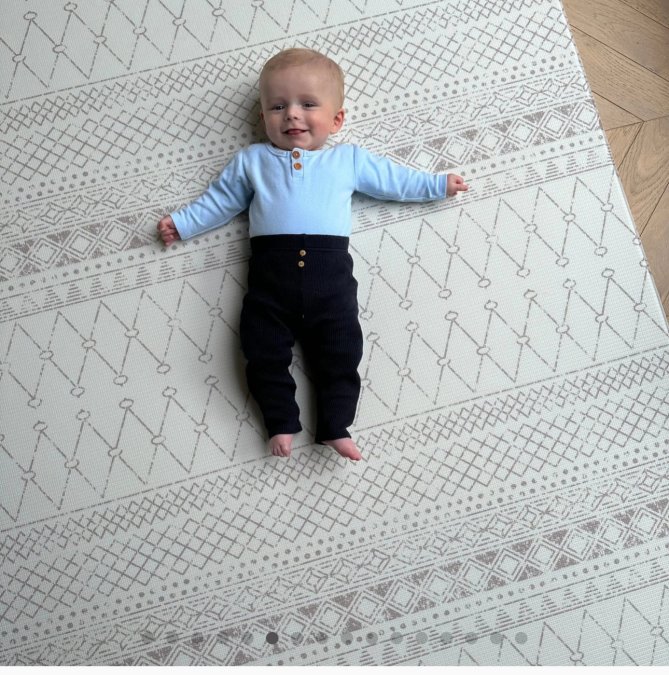
Beyond safety, a quality playmat cushions early falls, insulates against cold floors in winter, and creates a visual boundary that helps babies understand where play happens. Look for one that is easy to wipe clean and certified free from the chemicals you are trying to avoid.
The Best BPA and PVC Free Playmats for Play Areas
For dedicated play areas, the best BPA and PVC free playmats combine thickness, a non-slip backing, and a wipeable surface. Our top pick at Grace & Maggie is the Checkmate Denim / [The Streets Padded Playmat(/products/checkmate-denim-blue-large-padded-baby-playmat) in Large | graceandmaggie.com.au], which measures roughly 200cm by 140cm and offers 1.5cm of cushioned support. Its reversible design gives you a striking blue checkered print on one side for stylish everyday play, and a road and train track on the reverse for imaginative games as your child grows. At $219, it is a substantial mat, but the dual-sided design effectively gives you two play surfaces in one, and the materials are crafted to be free from BPA and PVC.
For families who want a softer, more organic aesthetic, the Streets / Mod Jute Padded Playmat in Large offers a neutral brown jute design that blends seamlessly into modern living rooms. The same 200cm by 140cm footprint and 1.5cm thickness provide consistent protection, while the reversible Mod side offers a clean, minimalist look. If you are working with a smaller space or want a portable option for travel, the Checkmate Denim / The Streets Padded Playmat in Small at 140cm by 100cm is an excellent choice at $129. Grace & Maggie is also a registered NDIS provider, which matters for families seeking funding support for sensory-friendly and accessible play equipment.
Selecting Safe Nursery Flooring Materials for Every Room
Safe nursery flooring materials are not limited to the nursery itself, because babies play wherever you are. In the living room, a large padded playmat protects your child on hard floors while keeping the space looking intentional. In a home office or gym area, the same mat can double as a comfortable exercise surface. The versatility of a quality mat means you are not buying a single-purpose item that gets discarded after the toddler years.

When thinking about safety across rooms, consider the traffic each space receives. A mat in a high-traffic hallway needs a durable, non-slip backing, while a mat in a quiet nursery corner can prioritise softness. Also consider hypoallergenic properties, particularly if your child has sensitive skin or you are managing allergies. For children with mobility aids, such as a wheelchair, a mat with a firm, non-slip base provides the grip needed for safe movement, an important consideration that Grace & Maggie addresses with its NDIS-registered product range.
Installation, Maintenance, and End-of-Life Considerations
The eco-friendliness of a nursery floor extends to how it is installed, maintained, and eventually disposed of. For hard flooring, installation is where many green credentials are lost, since traditional adhesives and sealants are a major source of VOC emissions. Choose a floating floor system or use low-VOC, water-based adhesives, and allow the room to air out completely before your baby uses it. For playmats, installation is far simpler: most high-quality mats roll out flat and require no adhesives at all.
Maintenance also affects both safety and longevity. Hard floors should be cleaned with water or mild, plant-based cleaners rather than harsh chemical sprays that leave residues. Playmats with a TPU coating can be wiped down with a damp cloth and mild soap, and they resist the staining that plagues cheaper foam mats. When your mat eventually reaches the end of its life, consider its recyclability. Many foam products are difficult to recycle, so choosing a durable mat that lasts for years, and can be passed down or repurposed, is the most sustainable option. Sustainability Victoria's guide to flooring and waste notes that the most environmentally friendly product is often the one that stays in use the longest, which supports investing in quality over disposable alternatives.
The Installation Safety Gap: Adhesives and Underlayments
Most eco-friendly flooring guides stop at the surface material, but the installation process can undo all your good intentions. The two hidden culprits are adhesives and underlayments. Solvent-based adhesives, commonly used for glue-down cork or vinyl, can release VOCs at levels that persist for weeks. Even some water-based adhesives contain ammonia or other additives. For a nursery, the safest installation method is a floating floor, where planks or tiles click together mechanically and sit on a separate underlayment layer, eliminating adhesive from the equation entirely.
If you must glue down a floor, look for adhesives labelled as zero-VOC or low-VOC. Avoid any product that lists "isocyanates" or "solvent-based" on the label. Recycled rubber underlayment, while marketed as eco-friendly, can contain process oils that off-gas; a better choice is a cork or wool felt underlayment, both of which are naturally derived and add acoustic and thermal insulation. After installation, ventilate the room for at least 72 hours before bringing in furniture or allowing your baby to spend time there.
Maintenance: The Chemistry of Cleaning
Once your floor is installed, the products you use to clean it become the new variable. Many conventional floor cleaners contain glycol ethers and synthetic fragrances that leave a residue and contribute to indoor air pollution. For hard floors, a simple solution of water and a few drops of plant-based dish soap is sufficient for daily cleaning. Avoid steam mops on cork or bamboo, as the moisture can penetrate the surface and cause swelling. For playmats, the TPU coating is a significant advantage: it is non-porous, so it does not harbour dust mites or mould, and it can be wiped with a mild soap solution without degrading. Never use bleach or alcohol-based wipes on a playmat, as these can break down the protective coating over time.
End-of-Life: What Happens When the Nursery Phase Ends?
The nursery phase is short, typically two to three years, which means the floor you choose will likely outlive its original purpose. The most sustainable option is to design for the next phase from the start. A neutral cork or bamboo floor can transition seamlessly into a playroom, a home office, or a guest bedroom. A high-quality padded playmat can be moved to a living room corner, repurposed as a yoga mat, or donated to a childcare centre. This approach aligns with the waste hierarchy: reduce, reuse, recycle, in that order.

When a product genuinely reaches the end of its useful life, the recycling options can be limited. Cork flooring can be composted in small quantities if it is free from synthetic finishes, but many composting facilities will not accept it. Bamboo and hardwood can often be recycled as timber, but only if they are not glued to an underlayment. Foam playmats are often challenging: many are made from mixed materials that cannot be separated, so they may end up in landfill. This is a strong argument for choosing a durable mat that lasts.
The Repurposing Opportunity
Rather than thinking of your nursery floor as a single-use product, consider how it can serve multiple purposes over its lifetime. A large padded playmat with a reversible design, such as the Grace & Maggie options, effectively gives you two surfaces in one. When your child outgrows the nursery, the mat can move to a playroom or be used as a crash mat for sensory play. Cork flooring, if installed as a floating system, can be lifted and reused in a smaller room or a home gym. Solid hardwood can be refinished multiple times, extending its life by decades. The most eco-friendly floor is the one that stays in use the longest.
Conclusion: Create a Healthy Floor for Your Little One
Building a healthy nursery floor is about layering: a sustainable hard base, a non-toxic finish, and a soft, chemical-free playmat on top. What goes into your floor affects the air your baby breathes, so it is worth taking the time to verify materials rather than trusting marketing labels. Start by auditing your existing space, replace the surfaces your baby touches most, and choose products that are genuinely free from BPA, PVC, and other harmful additives.
At Grace & Maggie, we have made it our mission to remove the guesswork from this decision. Our award-winning playmats are crafted from high-quality TPU coated memory foam, are free from BPA and PVC, and are designed to look beautiful in every room of your home. Whether you need a mat for a nursery, a living room play area, or a childcare setting, explore our range and find a safe, stylish foundation for your little one's adventures.
Frequently Asked Questions
What is the most eco-friendly flooring option for a nursery?
There isn't one single 'most' eco-friendly option, as it depends on your priorities. For a permanent floor, sustainably sourced timber,cork or bamboo are excellent renewable choices. For a play area, a high-quality TPU playmat that is free from BPA, PVC, and phthalates offers a safe, cushioned, and easy-to-clean surface. The best eco friendly nursery floor ideas often combine a natural base floor with a non-toxic playmat for comfort and safety.
Are TPU playmats considered eco-friendly and non-toxic?
Yes, TPU, or thermoplastic polyurethane, is generally considered a safer and more eco-conscious choice than PVC. Unlike PVC, TPU does not require harmful plasticisers like phthalates to be flexible. Our playmats are made from TPU-coated memory foam, are BPA and PVC free, and are designed without toxic off-gassing. This makes them a safe, durable, and recyclable option for your baby's play space.
What should I look for in safe nursery flooring materials?
Prioritise materials that are non-toxic, hypoallergenic, and contribute to good indoor air quality. Look for terms like 'VOC-free', 'formaldehyde-free', and 'non-off-gassing'. Solid wood, cork, and natural linoleum are all safe choices for flooring. For rugs and playmats, verify they are free from BPA, PVC, and phthalates. Always check that products meet relevant safety standards to ensure a child-safe environment.
How do I ensure nursery flooring meets Australian safety standards?
Look for products that comply with relevant safety standards. For playmats and children's products, this often involves testing for hazardous materials. Choosing products from reputable brands that clearly state their materials and safety testing is key. As a registered NDIS provider, we ensure our playmats meet strict safety and quality requirements, giving you confidence in a safe play environment.
A healthy floor is the foundation of a safe nursery, but finding the right balance of softness, safety, and style takes careful consideration. Grace & Maggie combines eco-friendly TPU coated memory foam with designs that grow with your family, all free from BPA and PVC. Shop the collection today and give your child a floor you can both feel good about.