

How to Choose Non Toxic Baby Brands for Childcare Settings
Last Updated: November 20, 2026
Quick Summary
Non toxic baby brands are makers whose materials and manufacturing choices reduce a child's exposure to harmful chemicals, and who prove it with recognised certifications rather than marketing language. Because non-toxic is not a regulated term in Australia, check for full material disclosure, a named third-party certification and a clear list of what the product is free from.
- Non-toxic is not a regulated term in Australia, so any brand can print it on a box.
- Apply a three-step test: disclosure, verification and exclusions, and file it as due diligence.
- BPA-free is a starting point, not a finish line; ask whether a product is PVC-free too.
- Check Australian mandatory standards as well as voluntary eco-certifications before signing a supply agreement.
- Assign each zone a surface: a large padded mat for the main play floor, a snuggle rug for calm corners.
Table of Contents
- What Non Toxic Baby Brands Actually Means in Practice
- Safe Materials for Baby Products: What to Look For and What to Skip
- Reading Baby Product Safety Labels Australia Educators Can Trust
- Why BPA-Free Nursery Products Are a Starting Point, Not a Finish Line
- Non Toxic Products for Childcare Centres: A Selection Checklist
- Non Toxic Baby Brands Available Around Langwarrin
- Building Your Setting's Non-Toxic Floor Plan
- Frequently Asked Questions
What Non Toxic Baby Brands Actually Means in Practice
Non toxic baby brands are product makers whose materials and manufacturing choices reduce a child's exposure to harmful chemicals, and who can prove it with recognised certifications rather than marketing language. The question we hear most from early learning services is simple: how do you tell a genuinely safer product from a label with a leaf on it?
"Non-toxic" is not a regulated term in Australia. Any brand can print it on a box. What separates a real claim from a slogan is evidence: named certifications, a full ingredient or material list, and a willingness to say what a product does not contain.
Our award-winning range is built for daycare centres, early learning environments and schools.
Safe Materials for Baby Products: What to Look For and What to Skip
The safest materials for baby products in shared care settings are those with a known composition, a wipeable surface and third-party certification. Vague "eco" plastics and heavily fragranced textiles should raise a flag.
Materials That Hold Up in High-Use Rooms
A childcare room is not a nursery. A mat in a toddler room might be walked on, spilled on, stacked on and wiped down several times a day. Material choice is a durability question as much as a safety one.
- TPU-coated foam: waterproof, wipeable, and hard-wearing under daily foot traffic.
- Memory foam: look for independent certification that tests foam content and emissions rather than simply describing it as "safe".
- Skip: unidentified soft plastics, strong synthetic fragrances, and any textile that lists no fibre composition at all.
For a deeper look at floor surfaces specifically, our guide to safe flooring for sensory needs walks through planning across a whole setting.
Reading Baby Product Safety Labels Australia Educators Can Trust
Australian educators should treat a label as a starting point, not a verdict. The most useful signals are named certifications (CertiPUR-US®, OEKO-TEX®), a complete materials breakdown, and country of design or manufacture. A label that says only "non-toxic" or "eco-friendly" with no supporting detail tells you almost nothing.
What "Non-Toxic" Actually Means, and Doesn't
"Non-toxic" is not a regulated term in Australia, and no single government standard governs its use. A credible claim rests on three things: full ingredient or material disclosure, third-party testing against a named standard, and a clear statement of what the product does not contain. If any is missing, treat the claim as marketing.
This matters in childcare because you are buying for shared rooms. A mat used by twenty children a day needs a paper trail you can show a parent or an authorised officer. Always ask suppliers for the certificate itself, not just a logo.
What Certifications Do and Do Not Guarantee
- Australian mandatory standards are separate again. Children's products such as cots, toys and some sleep products are subject to mandatory safety standards and bans enforced by the ACCC. A product can carry a voluntary eco-certification and still fail an Australian mandatory requirement, so check both.
Third-party certifications are verifiable checks you can ask any supplier to confirm in writing.
The ACCC product safety guidance is worth bookmarking for general product safety obligations, and Product Safety Australia publishes recalls and bans that apply to children's products. Check both before signing a supply agreement. A supplier who can't answer "which certification, and can I see the certificate?" is a supplier to walk away from.
A Practical Evidence Standard for Childcare Procurement
Use this three-step test when a supplier claims "non-toxic":
- Disclosure, is the full material list published, including foam type, fabric composition and any coatings or adhesives?
- Verification, is there at least one named third-party certification, and can the certificate be produced on request?
- Exclusions, does the supplier state explicitly what the product is free from (for example BPA, PVC, added fragrance), rather than relying on a single claim?
If a supplier passes all three, you have something you can file as due diligence. If they pass only one, you have a slogan.
Why BPA-Free Nursery Products Are a Starting Point, Not a Finish Line
BPA-free nursery products remove one chemical of concern, but they do not make a product non-toxic on their own. A mat can be BPA-free and still contain PVC, added fragrance or unlisted plasticisers. The claim is a floor, not a ceiling.
This trips up procurement teams. A tender says "BPA-free" and every supplier ticks the box, so the boxes look identical. They aren't. Ask the next question: PVC-free? What foam, and is it certified? What's the fabric composition? Our padded playmats are free from BPA and PVC, and we'd rather you hold every supplier to that standard.
Non Toxic Products for Childcare Centres: A Selection Checklist
Use this checklist as a scoring sheet when comparing suppliers. Score each product out of ten and keep the sheet on file, because it doubles as your due diligence record.
- Full materials list published, not just "non-toxic"
- At least one named third-party certification, with certificate available on request
- BPA-free and PVC-free stated explicitly
- Surface is waterproof and wipe-clean for daily use
- Non-slip base for active rooms
- Foam density and thickness stated in the spec sheet
- Care instructions included, including what not to do
- Returns policy clear before you remove packaging
- Australian-owned or designed
- Suitable for the specific room, not just the catalogue
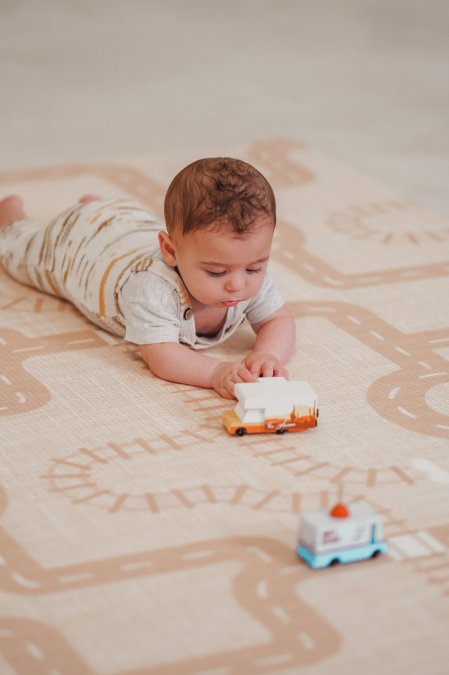
For a shoppable starting point, our waterproof baby play mats collection meets the checklist criteria for busy rooms.
Comparing Playmats, Snuggle Rugs and Sensory Seating
Three product types cover most childcare floor needs, and they are not interchangeable. A playmat takes the heavy traffic. A snuggle rug softens a reading or calm-down corner.
| Product | Best For | Price (AUD) |
|---|---|---|
| Forrest / Blush Padded Playmat, Small | Smaller rooms, quiet corners | $129.00 |
| Forrest / Blush Padded Playmat, Round | Play gym base, nursery finish | $179.00 |
| Forrest / Blush Padded Playmat, Large | Main play floor, group activities | $219.00 |
| Archer Earth Snuggle Rug | Reading corners, calm spaces | $169.00 |
| Pastel Dennis Snuggle Rug | Sensory spaces, neutral rooms | $189.00 |
| The Wanderer Vegan Leather Mat | Outdoor and excursion use | $149.00 |
Price (AUD)
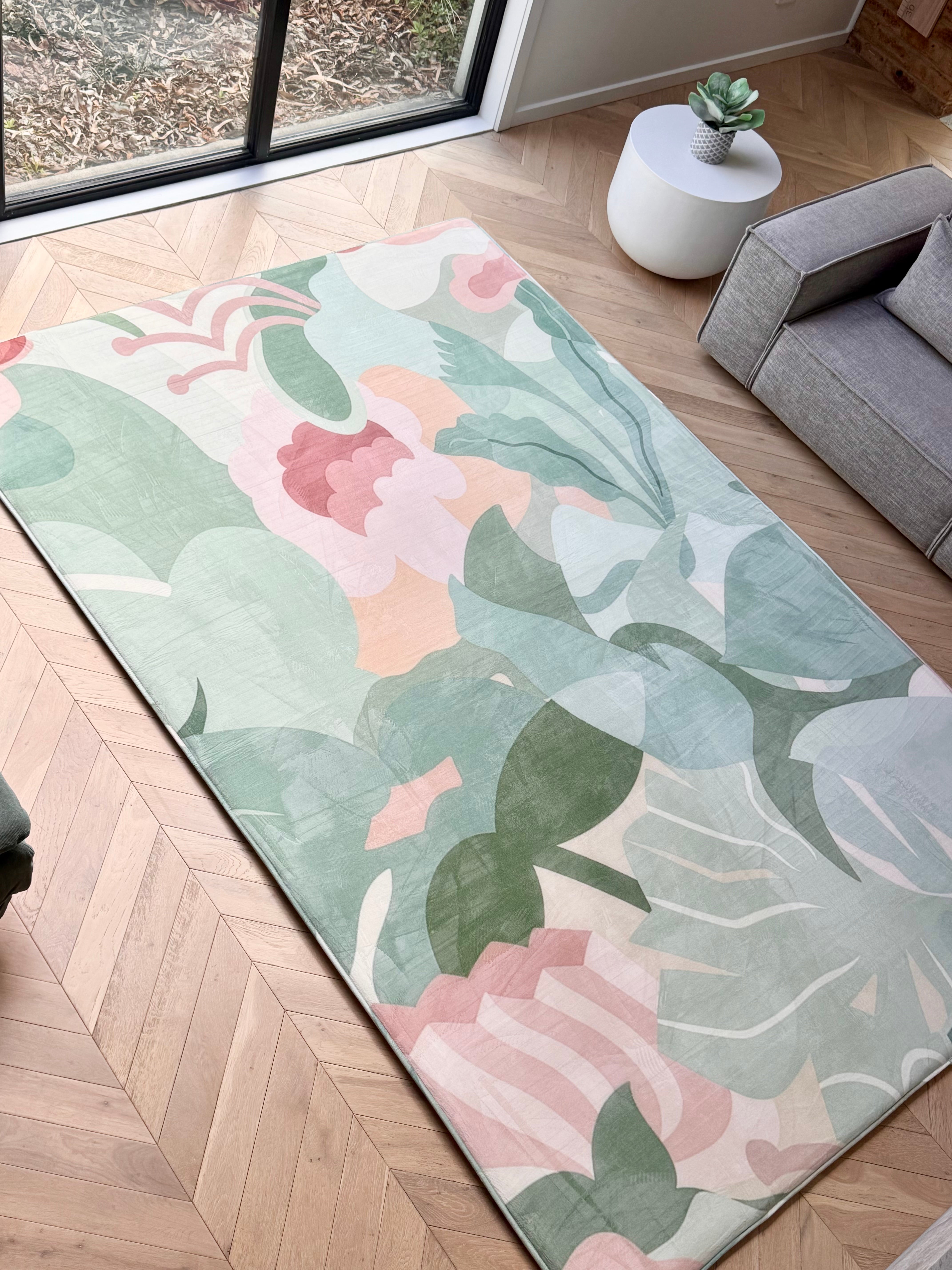
For a direct material comparison, our breakdown of TPU playmats versus memory foam snuggle rugs covers which surface suits high-use rooms, and you can browse the full snuggle rug range to compare sensory seating options.
Best for: high-traffic play floors and tummy time, the large padded playmat. Skip if: your room is under four square metres, in which case the small size is the better fit.
Non Toxic Baby Brands Available Around Langwarrin
Families and services can buy online with delivery, or check products before committing. Ask for certificates before ordering.
Local Availability and Delivery for Langwarrin Settings
For childcare and early learning services, the practical question is not just "which brand" but "can I get it, on a timeline that fits a fit-out?"
- Online delivery is the default for most centres. Confirm the delivery method and any freight for bulky items before you order.
- Inspection matters for foam products. Thickness and surface texture are hard to judge from a photo, so requesting a sample before a bulk order is worthwhile.
- Returns and certificates should be settled before delivery. Ask for the returns policy in writing.
A Dated Price and Availability Check
Prices and stock change, so confirm with the supplier before ordering. All amounts are in AUD.
| Product | Best For | Price (AUD) | Availability Note |
|---|---|---|---|
| Forrest / Blush Padded Playmat, Small | Smaller rooms, quiet corners | $129.00 | Online delivery to Langwarrin; confirm freight for bulky items |
| Forrest / Blush Padded Playmat, Round | Play gym base, nursery finish | $179.00 | Online delivery; check stock before a bulk order |
| Forrest / Blush Padded Playmat, Large | Main play floor, group activities | $219.00 | Online delivery; pallet freight may apply |
| Archer Earth Snuggle Rug | Reading corners, calm spaces | $169.00 | Online delivery; allow 48-72 hours to expand after unboxing |
| Pastel Dennis Snuggle Rug | Sensory spaces, neutral rooms | $189.00 | Online delivery; confirm lead time for centre orders |
| The Wanderer Vegan Leather Mat | Outdoor and excursion use | $149.00 | Online delivery; check suitability for outdoor storage |
For a direct material comparison, our breakdown of TPU playmats versus memory foam snuggle rugs covers which surface suits high-use rooms, and you can browse the full snuggle rug range to compare sensory seating options.
Best for: high-traffic play floors and tummy time, the large padded playmat. Skip if: your room is under four square metres, in which case the small size is the better fit.
For crawling babies specifically, our article on safe flooring options for crawling babies goes deeper into materials and what to check.
Building Your Setting's Non-Toxic Floor Plan
A non-toxic floor plan assigns each zone a surface based on how children actually use it, rather than covering the whole room in one product.
Start with the main play floor: a large padded mat handles group time and tummy time. Add a snuggle rug to the reading or calm-down corner. Put a portable mat by the door for outdoor and excursion use.
Getting a whole centre's flooring right is a project, not a purchase, and the gap between a genuinely safer room and a box that says "non-toxic" comes down to evidence. Grace & Maggie builds for that standard, with TPU padded playmats free from BPA and PVC and memory foam snuggle rugs, designed for early learning environments.
Frequently Asked Questions
What does non-toxic mean for baby products?
There is no single legal definition, so treat it as a claim to verify rather than a guarantee. In practice it usually means the product avoids certain materials or additives, such as BPA, PVC or added fragrance. Ask which specific substances are excluded and what testing backs the claim. Independent certifications on the label, plus a clear ingredient or material list, tell you more than the word non-toxic on its own.
Are BPA-free products automatically non-toxic?
No. BPA-free only confirms one substance is absent. A product can be BPA-free and still contain PVC, phthalates or added fragrance, so check the full material list. For playmats and floor surfaces, look for BPA-free and PVC-free together, plus foam or fabric certifications where offered. Treat BPA-free as one line on the checklist, not the whole answer.
What should childcare centres look for in non toxic baby brands?
Prioritise brands that publish material composition, hold recognised certifications and describe cleaning methods clearly. For floor products, check thickness, non-slip backing and whether the surface tolerates daily wiping. Ask about warranty terms and whether replacement parts are available. A brand that answers these questions in writing is easier to justify in a service's purchasing records than one that only markets with broad safety language.
How can educators assess product safety claims from baby brands?
Request documentation rather than relying on marketing copy. Ask for the material composition, any certification certificates and care instructions in writing. Cross-check that the certification named on the product page matches the certificate itself, including the standard number and the testing body. Keep this evidence on file with your purchase records so it can be produced during an assessment and review visit.
Are natural or organic baby products always safer?
Not automatically. Natural and organic describe sourcing, not finished-product safety, and a natural fibre surface can still sit on foam or backing that needs checking. Organic cotton certification covers the fibre, not the whole item. Read the complete material list and look for certifications covering each component. A product can be partly organic and still warrant questions about adhesives, dyes or flame retardants.
