


Safe Flooring Options for Crawling Babies: 7 Top Picks
Table of Contents
- Quick Comparison: Safe Flooring Options at a Glance
- Why Non-Toxic Baby Play Mats in Australia Matter
- 1. TPU Coated Memory Foam Playmats: The All-Rounder
- 2. High-Density Sensory Tatami Rugs: Best for Sensory Needs
- 3. Durable Playmats vs Standard Rugs for High Traffic Areas
- 4. How to Baby Proof Hardwood Floors: A Step-by-Step Approach
- 5. Portable and Multi-Functional Picks for Small Spaces
- Conclusion
- Frequently Asked Questions
Last Updated: September 12, 2026
Quick Comparison: Safe Flooring Options at a Glance
Safe flooring for a crawling baby comes down to three things: what it's made of, how much it cushions a fall, and whether you can actually clean it. This guide from Grace & Maggie breaks down the seven options worth considering, from TPU coated memory foam playmats to sensory tatami rugs and portable outdoor mats.
Here's the short version before we get into the detail:
Option |
Thickness |
Best For |
Price |
|---|---|---|---|
TPU coated memory foam playmat |
15mm |
All-round family use |
$219.00 |
Sensory tatami snuggle rug |
35mm |
Sensory needs, tummy time |
$179.00 |
Padded playmat (reversible) |
15mm |
High-traffic living areas |
$219.00 |
Vegan leather outdoor mat |
2mm |
Portability, park and beach |
$149.00 |
Foam mirror activity wedge |
n/a |
Tummy time support |
$39.00 |
Sensory lounger |
25kg/m³ foam |
Reading, quiet corners |
$269.00 |
The 35mm snuggle rug is the thickest option here, and thickness matters more than most parents realise when a newly mobile baby is testing out gravity. Below, we'll walk through each pick, what it suits, and where it falls short.

Why Non-Toxic Baby Play Mats in Australia Matter
A crawling baby spends hours a day with their face, hands and mouth against the floor. That makes the material under them a genuine safety question, not a design detail.
Cheap foam mats can contain PVC, phthalates or formaldehyde, and those are the things you want to avoid in a space where a baby is mouthing everything in reach. Look for BPA-free and PVC-free construction, and check whether the foam carries certification against recognised safety standards.
The Australian Competition and Consumer Commission enforces mandatory safety standards for toys and children's products, and Product Safety Australia's guidance on children's products is worth reading before you buy anything your baby will lie on daily.
1. TPU Coated Memory Foam Playmats: The All-Rounder
TPU coated memory foam is the best all-round choice for a crawling baby because it combines a waterproof, wipeable surface with a cushioned memory foam core that absorbs impact.
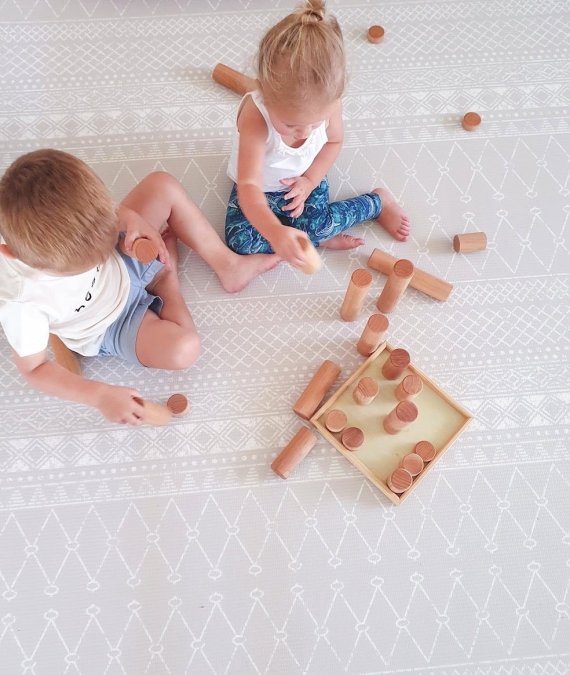
TPU, or thermoplastic polyurethane, is a flexible, hypoallergenic material that's free from BPA and PVC. It doesn't hold stains the way fabric does, and a damp cloth handles most spills. Underneath, memory foam gives you the shock-absorbent cushioning that protects a wobbly crawler's knees and head.
Weight and thickness are the trade-off nobody mentions. A 15mm mat is light enough to roll up and move between rooms, while a 35mm mat cushions better but weighs more and takes longer to flatten after shipping. For most apartments, 15mm hits the sweet spot.
Forrest / Blush Padded Playmat: Style Meets Safety
Forrest / Blush - Padded Playmat - Large is a double-sided mat measuring roughly 200cm x 140cm x 1.5cm, priced at $219.00. One side is a soft geometric design, the other a trademark print, so it works in a living room without looking like a nursery cast-off.
Pros: waterproof and wipeable, reversible design, doubles as a workout base Cons: 15mm is thinner than a dedicated sensory rug, so it suits crawlers more than rough-and-tumble toddlers
2. High-Density Sensory Tatami Rugs: Best for Sensory Needs
High-density sensory tatami rugs are the best pick for children with sensory processing needs because their 35mm slow-rebound foam creates a deep, supportive surface that absorbs impact and encourages floor-based play.
Density is the number that separates a rug that lasts from one that flattens in months. A 35D foam rating means the material holds its shape under repeated use, rather than compressing into a thin patch where your child plays most. This same principle of structural integrity applies when selecting materials for child proofing furniture to ensure that corners and edges remain resilient against the constant impact of a growing toddler.
Dennis Snuggle Rug: 35mm of Cushioned Support
The Dennis - by Studio Dennis Snuggle Rug - Sensory Tatami Mat expands to 35mm and uses 35D high-density slow-rebound foam, priced at $179.00. The short-pile surface keeps allergens low, and the nonslip base holds it in place on timber floors.
Pros: thickest option here, nonslip base, anti-spill surface Cons: needs 48 to 72 hours to fully expand after unboxing, and it can't be machine washed
3. Durable Playmats vs Standard Rugs for High Traffic Areas
Durable playmats beat standard rugs in high-traffic areas because a wipeable TPU surface resists stains that would sink permanently into fabric fibres.
A standard rug is a sponge. Milk, puree and the occasional nappy incident soak straight in, and by the time you notice, the stain has set. A padded playmat gives you time to wipe the spill before it penetrates, and a damp cloth finishes the job.
Floor protection is the other factor. A padded mat spreads weight and softens the impact of dropped toys on timber, and it stops the scratches that come from hard plastic wheels and blocks dragged across the boards.
If you're weighing up a dedicated playmat against a general rug, ask one question: how often will this surface meet a spill? If the answer is daily, the mat wins.
4. How to Baby Proof Hardwood Floors: A Step-by-Step Approach
Baby proofing hardwood floors means covering the hard surface with a shock-absorbent layer, securing the edges, and removing the slip risks that cause most falls.
Here's the practical sequence:
- Measure your play zone. Mark out where your baby actually spends floor time, not the whole room.
- Check for splinters and gaps. Run your hand across the boards and fill any gaps wider than a finger.
- Add a cushioned layer. A padded playmat or snuggle rug provides the cushioned landing a bare board can't.
- Secure the edges. Tuck or tape down any loose corners to stop trips.
- Anchor heavy furniture. Bookcases and TV units should be fixed to the wall (kidsafe.com.au).
- Test for slip. Push the mat with your foot; a nonslip base should hold firm.
Kidsafe's home safety guidance recommends checking floor surfaces and furniture stability as part of any room-by-room safety review.
5. Portable and Multi-Functional Picks for Small Spaces
Portable, multi-functional mats are the best choice for small spaces because they fold or roll away for storage and double as a surface for exercise, picnics and quiet play.
Apartment living changes the brief. You don't have a spare room to dedicate to play, so the floor surface has to earn its place. A mat that rolls up behind the couch or folds into a tote solves the storage problem that a fixed rug creates.
The The Wanderer: Tan Vegan Leather Outdoor Mat measures 2000mm x 1350mm and folds into a canvas tote, priced at $149.00. It's made from non-toxic vegan leather, so it moves from the living room to the park without fuss.

For tummy time in tight corners, the The TumTime - Foam Mirror Activity Wedge at $39.00 adds a mirror and rattle for sensory play without taking up floor space.

Pros: foldable, lightweight, easy storage, works indoors and out Cons: the 2mm outdoor mat offers far less cushioning than a foam playmat
Acoustic dampening is the quiet bonus. Thick foam mats absorb some of the sound that bounces off hard floors, which matters more than you'd think in an apartment with neighbours below.
Conclusion
Choosing safe flooring for a crawling baby gets easier once you stop chasing the cheapest mat and start matching the material to your actual space. Thickness, density and a wipeable surface do more for safety than any label.
Grace & Maggie builds designer playmats and memory foam rugs from TPU coated memory foam that's free from BPA and PVC, with 35D high-density foam options, nonslip bases and easy-clean surfaces for every room. As a registered NDIS provider and 2025 Bounty Award winner, the range covers compact apartments and full playrooms alike.
Get started with Grace & Maggie and give your crawler a floor worth exploring.
Frequently Asked Questions
What is the safest flooring material for a crawling baby?
A high-density foam mat with a non-toxic, wipeable cover is the safest option for crawling babies. Look for materials free from BPA, PVC, phthalates and formaldehyde. A 35D density foam at 35mm thick absorbs impact from tumbles while providing enough grip for crawling and pulling up. Avoid loose rugs that can bunch or slide under small hands and knees.
Are foam play mats safe for babies?
Foam play mats are safe when the foam and cover are free from harmful chemicals. TPU coated memory foam mats are a strong choice because TPU contains no BPA or PVC and is hypoallergenic. Avoid cheaper mats with strong chemical odours or unclear material listings. A quality foam mat also provides shock absorption for those early crawling and tumbling stages.
How do I choose a non-toxic play mat for my baby?
Start by checking the material list: TPU coated memory foam or vegan leather are non-toxic options. Avoid mats labelled only as 'foam' with no chemical breakdown. A waterproof, wipeable surface matters too, because it stops spills soaking into the foam where mould can grow. Finally, check the density: 35D foam holds its shape far longer than lower-density alternatives.
Is memory foam flooring better than standard rugs for babies?
Memory foam flooring outperforms standard rugs for crawling babies in three ways. First, impact absorption: 35mm of 35D slow-rebound foam cushions falls far better than a flat-weave rug. Second, hygiene: a waterproof, wipeable surface stops spills and stains soaking in, while standard rugs trap dust mites and allergens. Third, stability: a non-slip base keeps the mat flat, whereas standard rugs bunch and slide. The trade-off is cost and the fact that foam mats are not machine washable.
How do I clean baby play mats effectively?
For TPU coated memory foam mats, wipe spills immediately with a damp cloth and mild soapy water. Vacuum the surface weekly to remove dust and crumbs. For stubborn stains, use a mild detergent on a soft cloth and avoid harsh chemicals or abrasive scrubbers, which damage the coating. Never machine wash or soak a foam mat, as water breaks down the foam structure. Keep mats out of direct sunlight and away from heat sources to prevent discolouration over time.