


Durable Mats for Active Toddlers: 2026 Buyer's Guide
Table of Contents
- Quick Comparison: Durable Mats for Active Toddlers
- What Makes a Playmat Durable Enough for Active Toddlers?
- Non-Toxic Play Mats Australia: What to Look For
- Stylish Playmats That Match Home Decor
- How to Clean Toddler Play Mats Without Damaging Them
- Commercial Grade Play Mats for Daycare and Early Learning
- Common Mistakes When Choosing Durable Mats for Active Toddlers
- Frequently Asked Questions
Last Updated: October 1, 2026
Quick Comparison: Durable Mats for Active Toddlers
Choosing durable mats for active toddlers comes down to three things: what the mat is made of, how thick it is, and whether it stays put when a two-year-old launches off the couch. This guide from Grace & Maggie covers the materials, safety checks and cleaning routines that actually matter in a busy Australian household or early learning room.
Below, we'll show you exactly how to spot a mat that survives daily tumbles, snack spills and block towers, and which options suit everything from a Langwarrin playroom to a daycare floor.
The quick picks below compare the Grace & Maggie range across size, material and best use.
| Mat | Material | Size | Best For |
|---|---|---|---|
| Padded Playmat (double-sided designs) | TPU-coated foam, free from BPA and PVC | Approx 200cm x 140cm x 1.5cm | Living rooms, playrooms, tummy time |
| Snuggle Rug - The Streets Earth | 35D memory foam, water-resistant | Round | Sensory corners, reading nooks, quiet time |
Both are hard-wearing and designed to blend into shared living spaces rather than shout "baby gear".

What Makes a Playmat Durable Enough for Active Toddlers?
A durable mat for active toddlers is one that keeps its shape, grip and surface after months of jumping, dragging and wiping. Three things decide that: material, thickness and the backing underneath.
Most cheap mats fail at the backing first. The foam is fine, but the base slides across floorboards the moment a toddler runs onto it. That's the part nobody tells you about until you've watched a mat shoot out from under a running child.
Material, Thickness and Non-Slip Backing
TPU-coated foam is the current standard for hard-wearing playmats. It resists cracking, wipes clean and holds colour better than older PVC mats, which is why it's now common in childcare settings.
Thickness matters more than most parents expect. At around 1.5cm, a mat cushions a fall from standing without making the floor feel spongy or unstable for walking toddlers.
Grip is the third piece. A non-slip base or branded nonslip bottom keeps the mat anchored, which matters for kids who use wheelchairs, walkers or sensory seating, not just crawlers.
Non-Toxic Play Mats Australia: What to Look For
Non-toxic play mats in Australia should be free from BPA, PVC and latex, and ideally carry independent certification for the foam and fabric. Those three chemicals are the ones parents ask about most, and for good reason.
Grace & Maggie playmats are made from TPU foam and are free of latex, BPA and PVC.
For Australian buyers, it helps to know that products marketed as "non-toxic" aren't automatically verified. Ask for the certification name, not just the claim. The ACCC product safety guidance for toys and childcare articles sets out the mandatory standards that apply to items intended for children, and it's worth a quick read before you buy anything a toddler will chew, crawl on or nap beside.
- Free from BPA, PVC and latex
- Hypoallergenic and waterproof surface
If your child has sensitive skin or you're managing eczema, a waterproof TPU surface is easier to keep genuinely clean than a fabric mat, because you can wipe it rather than wash and dry it.
Stylish Playmats That Match Home Decor
Stylish playmats that match home decor solve the problem most parents hit around the twelve-month mark: the play space takes over the living room, and the mat is the thing that makes it look messy. Reversible designs fix this by giving you two looks in one mat.
The Forrest / Grey Padded Playmat is a good example. One side is a whimsical forest scene with hand-drawn bears and foxes in taupe and grey. Flip it over and you get a clean geometric grid in light grey and white that suits a modern living room.
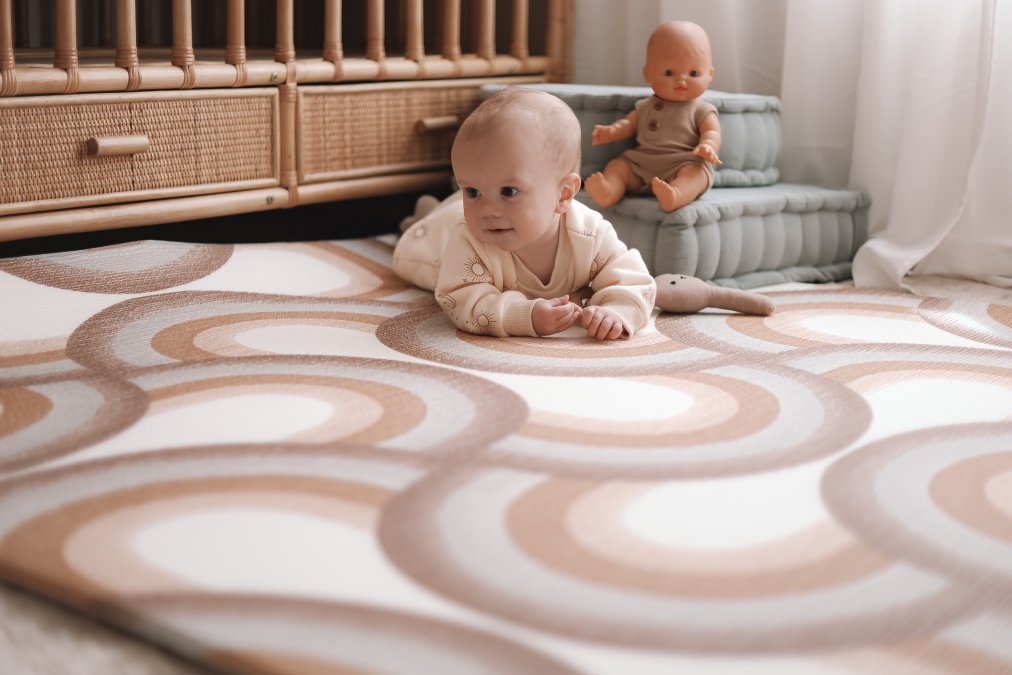
Other options lean harder into texture. The Webster / The Streets mat mimics a looped area rug on one side, so it reads as a rug rather than a playmat, while the reverse carries a track design for imaginative play. The Archie / The Streets mat takes a similar approach with a Japandi arch print in grey and beige.

For smaller apartments, the round Snuggle Rug in Earth tones works in tighter spaces because it doesn't need to run wall to wall. It's designed for reading corners and quiet zones rather than full-room coverage.
How to Clean Toddler Play Mats Without Damaging Them
Cleaning a toddler play mat takes about two minutes a day and one deeper clean a week. The method depends on whether your mat has a TPU coating or a memory foam surface, because the wrong product will dull the finish or damage the foam.
For TPU-coated padded playmats, wipe with a damp cloth or a gentle baby wipe. That handles milk, puree and most craft spills. Avoid abrasive cleaners, bleach, and direct sunlight or heat sources, all of which break down the coating over time.
Memory foam Snuggle Rugs need a slightly different routine. Vacuum regularly to lift dust and crumbs, then spot clean spills with a damp, soapy cloth. The water-resistant coating gives you a few seconds before liquid soaks in, so keep a cloth nearby during snack time.
- Daily: wipe the surface with a damp cloth
- Weekly: vacuum the Snuggle Rug to keep fibres fresh
- Spills: blot immediately with a damp, soapy cloth
- Stubborn marks: mild detergent on a soft cloth only
- Never: machine wash, soak, or use bleach and abrasive scrubbers
One thing to watch: avoid placing heavy furniture on any foam mat, as it can leave permanent indentations.
Commercial Grade Play Mats for Daycare and Early Learning
Commercial grade play mats for daycare and early learning need to survive a room of fifteen toddlers, a daily cleaning schedule and years of use. That's a different brief from a home playmat, and the specs that matter shift accordingly.
- Wipe-clean TPU surface for between-session hygiene
- Non-slip base for safety during active play
- Reversible designs that suit shared and multi-use rooms
- Memory foam Snuggle Rugs for reading corners and quiet zones
Common Mistakes When Choosing Durable Mats for Active Toddlers
The biggest mistake is buying on thickness alone. A 3cm mat with a slippery base is less safe for a running toddler than a 1.5cm mat that stays put.
Here's what to watch for:
| Mistake | Why It Backfires | What to Do Instead |
|---|---|---|
| Choosing thickness over grip | Thick mats still slide on timber and tiles | Test the backing first, then compare thickness |
| Ignoring the material | PVC mats crack and fade faster than TPU | Look for TPU-coated foam |
| Skipping checks | "Non-toxic" claims aren't always verified by default | Ask for relevant certifications |
| Buying for one room only | Play moves; mats stay behind | Pick a reversible design that suits multiple spaces |
| Using the wrong cleaner | Abrasive products dull the coating | Wipe with a damp cloth or gentle baby wipe |
| Machine washing memory foam | It breaks down the foam structure | Spot clean only, vacuum weekly |
Frequently Asked Questions
What material is best for a durable toddler playmat?
TPU-coated foam is the most durable option for active toddlers. It resists cracking, handles daily wiping and stays waterproof without the chemical smell associated with PVC. Look for mats that are free from BPA, PVC and latex, and that have been tested to international toy safety standards. Memory foam with a water-resistant coating is another solid choice for quieter play zones and sensory corners.
How do I clean a playmat used by active toddlers?
Wipe TPU playmats with a damp cloth or gentle baby wipe after each use. For sticky spills, use mild soap and water, then dry immediately. Avoid bleach, abrasive cleaners and direct sunlight, which can break down the surface over time. Memory foam snuggle rugs need regular vacuuming and spot cleaning only. Never machine wash or soak foam-based mats, as moisture damages the core.
Are TPU playmats safe for toddlers?
Yes. TPU (thermoplastic polyurethane) is a non-toxic material free from BPA, PVC and latex. Quality TPU playmats are tested against international toy safety standards and are hypoallergenic, making them suitable for sensitive skin. They are also waterproof, so spills and accidents do not soak into the foam. Always check that the mat explicitly states it is free from these chemicals before buying.
How thick should a playmat be for active play?
A thickness of around 1.5cm works well for active toddlers. It provides enough cushioning to soften falls during crawling, tumbling and running without being so thick that the mat becomes unstable underfoot. For sensory spaces or quiet corners, a memory foam rug with a higher density foam offers extra plushness. Thinner mats under 1cm do not absorb impact well enough for daily active play.
How long should a high-quality playmat last?
A well-made TPU playmat used daily in a home setting can last several years. In a childcare or early learning centre with constant use, expect two to three years before visible wear. Longevity depends on the material quality, how well you maintain it and whether it is used on appropriate surfaces. Following the care instructions and avoiding heavy furniture on the mat extends its lifespan significantly.