

Non Toxic Playmats for Babies: Materials & Safety Guide
Table of Contents
- What Makes a Playmat Non-Toxic?
- TPU vs PVC Playmats: What the Foam Actually Means
- Safety Standards and Certifications to Check
- Choosing the Right Size and Thickness for Your Space
- Easy-to-Clean Baby Play Mats: Maintenance That Actually Works
- Building a Safe Play Space for Toddlers
- Comparison Table: Non Toxic Playmats for Babies
- Frequently Asked Questions
Last Updated: September 16, 2026
What Makes a Playmat Non-Toxic?
A non-toxic playmat is made without the harmful chemicals common in cheap foam flooring: PVC, BPA, phthalates, and formaldehyde. For parents searching for non toxic playmats for babies, it comes down to two things, the base material and the coating on top.
Materials to Avoid: PVC, BPA and Phthalates
PVC is the first material to watch for. It is naturally rigid, so manufacturers add plasticisers called phthalates to soften it, the main reason PVC playmats raise concerns.
TPU vs PVC Playmats: What the Foam Actually Means
The biggest decision in choosing a safe mat is the foam itself, where TPU vs PVC playmats diverge.
TPU Foam vs EVA Foam
EVA foam sits in the middle: lighter and cheaper than TPU, and common in budget playmats. But EVA quality varies enormously, and cheaper versions can carry the same additive concerns as PVC.
Safety Standards and Certifications to Check
Certifications verify a claim instead of asking you to trust it. "Non-toxic" on a box means little on its own; independent VOC emissions testing means a great deal.
The Australian framework you are actually buying into
There is no single Australian standard titled "non-toxic playmat". Instead, a children's playmat sits at the intersection of several regulatory and voluntary layers:
- Australian Consumer Law, enforced by the ACCC and state fair trading agencies, requires products to be safe for their intended use. A playmat marketed for babies must not present a foreseeable hazard, and a supplier cannot disclaim that duty with a label.
- AS/NZS ISO 8124 is the joint Australian/New Zealand toy safety standard series. Part 3 covers migration of certain elements (heavy metals such as lead, cadmium, and mercury), and Part 1 covers mechanical and physical properties. A foam playmat is not automatically a "toy", but suppliers who test to 8124 are voluntarily applying the closest relevant benchmark.
- AS/NZS 8124.1 also addresses small parts and edge hazards, which matters for modular mats with interlocking pieces.
- The mandatory standard for toys for children up to 36 months (Consumer Goods (Toys for Children up to and including 36 Months of Age) Safety Standard) bans certain phthalates in toys and childcare articles. A playmat is not a toy in the strict legal sense, but the phthalate limits in that instrument are the reference point most reputable suppliers work to.
- Formaldehyde and VOC emissions are not covered by a single mandatory Australian standard for playmats. This is precisely why third-party emissions testing is the differentiator, it fills a gap the law leaves open.
What off-gassing testing actually measures
Off-gassing is the release of volatile organic compounds (VOCs) from new foam, adhesives, and coatings. Smell is a poor proxy for risk, the useful question is not "does it smell?" but "what was measured, in what chamber, and at what limit?"
A credible emissions report will normally state:
- The test chamber method. The two common approaches are a small-scale chamber (often described as a 1 m³ or similar environmental chamber) and a desiccator or micro-chamber method. Chamber testing is the more realistic simulation of a nursery because it accounts for the way VOCs accumulate in a closed room.
- The conditioning period. Samples are usually conditioned for a set number of days before measurement. A report that tests at day 1 and day 28 tells a very different story from one that tests only at day 1.
- The specific compounds screened. Look for total volatile organic compounds (TVOC) plus individual markers such as formaldehyde, benzene, toluene, and xylene. A report that says only "VOC tested, pass" without listing compounds is not useful.
- The limit applied. Different schemes use different thresholds. Without a stated limit, a "pass" is meaningless.
Other markers worth checking
Beyond VOCs, the claims that carry real weight are:
- Heavy metal migration testing to AS/NZS ISO 8124.3 limits.
- Phthalate-free confirmation referencing the 36-month mandatory standard limits.
- Formaldehyde-free confirmation, ideally with a stated detection limit.
- Hypoallergenic materials, a useful signal for babies with eczema or sensitive skin, though "hypoallergenic" is a marketing term rather than a regulated standard.
For Australian buyers, the checklist is simple: does the supplier name the standard, name the test method, and offer the report on request? If all three are yes, they understand the difference between a claim and a certification.
Choosing the Right Size and Thickness for Your Space
Size and thickness come down to three questions: how much floor you need to cover, how much cushioning your child needs at their current stage, and what is underneath the mat.
Match the mat to the developmental stage
Most guides treat a playmat as a single purchase for one phase. In practice, the surface a baby needs at four months is not the one they need at eighteen months.
Forrest / Blush - Padded Playmat - Large →
- Tummy time (roughly 0-6 months). The priority is a firm, stable surface. A mat that is too soft lets a baby sink, which makes pushing up on the arms harder and shortens tummy time. Around 1.5cm of closed-cell foam is the sweet spot: enough cushioning for a face-plant, firm enough to push against.
- Rolling and early crawling (roughly 6-12 months). This is where surface area matters more than thickness. A baby learning to roll needs uninterrupted space, because a mat edge interrupts the movement. A mat around 200cm x 140cm gives room to roll in both directions without hitting a boundary.
- Cruising and toddler play (roughly 12-36 months). The risk profile changes from face-plants to falls from standing height. The mat needs to absorb impact without being so thick that it becomes a trip hazard at the edges. A bevelled or low-profile edge helps here.
- Sensory and mobility needs. For children who use wheelchairs or support equipment, grip and a firm, non-sinking surface matter more than plushness. A mat that compresses unevenly under wheels is harder to manoeuvre on, not easier.
Size guidance by room
| Space | Suggested Size | Thickness | Best For |
|---|---|---|---|
| Small apartment or corner | 140cm x 100cm | 1.5cm | Tummy time, compact rooms |
| Living room or nursery | 200cm x 140cm | 1.5cm | Rolling, crawling, shared spaces |
| Dedicated play zone | 200cm x 140cm or larger | 1.5cm | Crawling, toddler play, multiple children |
| Multi-use home gym | 200cm x 140cm | 1.5cm | Play plus at-home workouts |
A reversible design gets you more value here. Grace & Maggie's Forrest range, for example, gives you a soft geometric side and a trademark design side on the same mat, so one purchase covers both a play space and a styled living room.

What is under the mat changes everything
This is the part most guides skip. The same mat performs very differently on timber, tile, concrete, and carpet.
- On tile or concrete. These are the coldest and hardest surfaces in most homes. Foam is a poor conductor of heat, which is exactly why a 1.5cm mat feels noticeably warmer than the bare floor, the foam traps a layer of still air between the baby and the slab. On these surfaces, thickness also does more work, because there is no give in the substrate beneath.
- On timber. Timber is warmer than tile and has a small amount of flex. A 1.5cm mat is usually sufficient, and the main concern shifts to grip, since polished boards are slippery.
- On carpet. Carpet already provides cushioning and warmth, so the mat's job changes to providing a clean, wipeable, allergen-friendly surface rather than impact absorption. On thick carpet, a very soft mat can feel unstable, which is another argument for a firmer closed-cell foam.
- Over underfloor heating. Foam insulates, so a thick mat will noticeably reduce the heat reaching the surface. If the mat sits over a heated floor, a thinner mat or a mat with a breathable backing will feel warmer.
Easy-to-Clean Baby Play Mats: Maintenance That Actually Works
Easy-to-clean baby play mats are ones with a sealed, wipe-clean surface rather than an absorbent fabric top. The coating is what stops spills, spit-up, and food from soaking in and turning into a permanent stain.
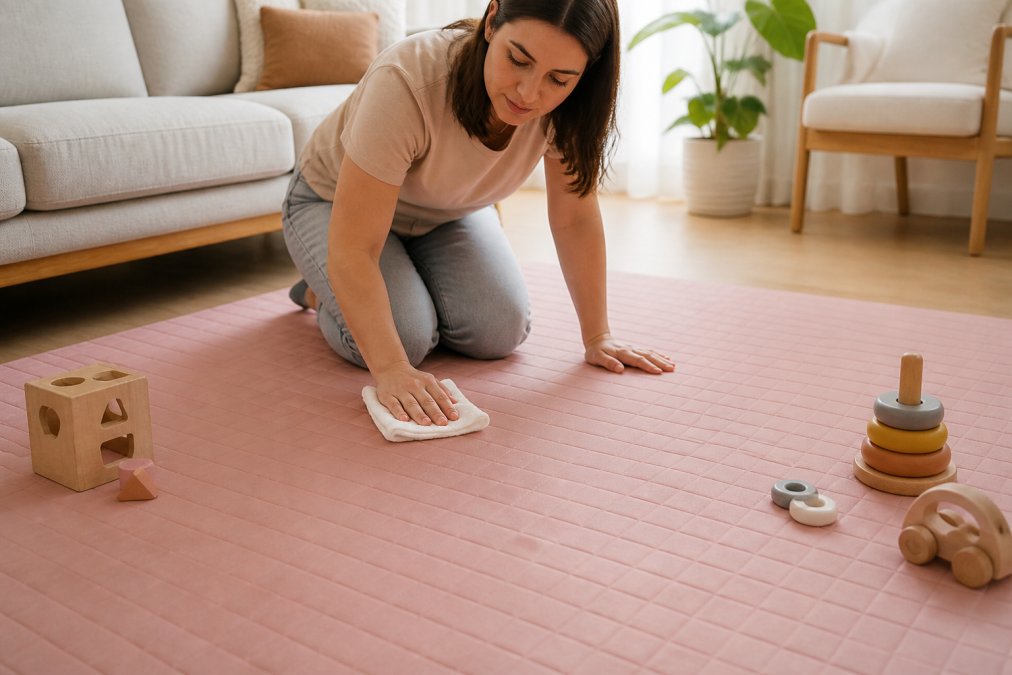
The single best maintenance habit is a quick wipe after every use. Two minutes a day prevents the deep-set stains that no cleaner can fully remove later.
Building a Safe Play Space for Toddlers
A safe play space for toddlers is about more than the mat alone, though the mat is the foundation. Once a child is mobile, the floor surface becomes the base layer that everything else sits on.
Comparison Table: Non Toxic Playmats for Babies
| Feature | Grace & Maggie Playmats | Typical Budget Foam Mats |
|---|---|---|
| Material | TPU coated memory foam | PVC or EVA foam |
| BPA and PVC | Free from both | Often contains one or both |
| Phthalates | Phthalate-free | Commonly used as plasticisers |
| Surface | Waterproof, wipe-clean | Varies, often absorbent |
| Thickness | 1.5cm | Often thinner |
| Design | Reversible, designer patterns | Single design |
| NDIS | Registered provider | Not applicable |
| Price | From $129 (small), $219 (large) | Lower upfront cost |
The upfront price gap is real and is the most common objection we hear. You are paying for the material and the testing, not the brand name.
Frequently Asked Questions
What is the safest non-toxic playmat for babies?
The safest non toxic playmats for babies use TPU foam rather than PVC or EVA, and avoid BPA, phthalates and formaldehyde. Look for mats that state their material clearly, carry independent testing for heavy metals and VOC emissions, and have a non-slip surface. Thickness of around 1.5cm gives enough cushioning for tummy time and early crawling without making the mat hard to move.
Are PVC and BPA-free playmats actually safer?
A PVC-free, BPA-free label is a starting point, not a guarantee. PVC requires plasticisers such as phthalates to stay soft, so a mat made from TPU or natural rubber removes that concern at the source rather than just avoiding one chemical. Ask what the mat is made from, not only what it excludes. Mats that are also phthalate-free and formaldehyde-free give you a clearer picture of what is actually in the foam.
How do I clean a non-toxic baby playmat?
Most TPU-coated playmats have a waterproof surface you can wipe clean with a damp cloth and mild soap. Wipe up spills and food straight away, then dry the surface fully before use. For a deeper clean, use a diluted gentle detergent and avoid abrasive scrubs, bleach or solvent cleaners, which can break down the coating. A quick daily wipe keeps the mat hygienic without stripping the surface.
What should I look for when buying a playmat for a newborn?
Prioritise material transparency, cushioning and grip. A newborn spends most of their floor time on their back or during tummy time, so a mat around 1.5cm thick with impact absorption supports them comfortably. Check for a non-slip surface, a waterproof and wipe-clean top layer, and reversible designs if you want the mat to suit more than one room. Size matters too: a smaller mat suits apartments, while a larger one gives crawling room.
Are there safety standards for baby playmats?
There is no single mandatory standard specifically for baby playmats in Australia. Instead, mats are caught by general product safety expectations and voluntary testing for things like heavy metals, phthalates and VOC emissions. Reputable brands commission independent testing and publish the results. When a mat is marketed as non-toxic, ask which tests were run and whether the results are available, rather than relying on the claim alone.
Can a playmat help with a child who has sensory or mobility needs?
A cushioned, non-slip mat can provide a more stable and comfortable floor surface for children with sensory processing needs or limited mobility. Thicker memory foam absorbs impact and reduces slipping underfoot, which matters for children using mobility aids. Some providers are registered NDIS providers, which means eligible participants may be able to use funding toward a suitable mat. Confirm registration status before you apply.