


How to Buy Eco Friendly Playmats in Australia: 2026 Guide
Table of Contents
- What to Check Before You Buy Eco Friendly Playmats
- Size, Thickness and Cushioning: Matching the Mat to Your Space
- TPU vs PVC Playmats Safety: What the Differences Actually Mean
- How to Clean Foam Playmats Without Damaging Them
- NDIS Registered Playmat Providers: How Funding Works
- Eco Friendly Playmats Compared: Prices, Materials and Best Uses
- Common Mistakes When Buying Eco Friendly Playmats
- Frequently Asked Questions
Last Updated: September 22, 2026
What to Check Before You Buy Eco Friendly Playmats
Most playmat listings lead with cute prints. The details that actually matter sit further down the page, if they appear at all. If you're trying to buy eco friendly playmats, start with the material and the certification, not the design.
An eco friendly playmat is a floor mat made from materials chosen to reduce chemical exposure and environmental impact, typically free from PVC, BPA and phthalates. The best options combine a non-toxic foam core with a wipe-clean top layer that survives daily spills, stains and bare feet.
Grace & Maggie builds its range around exactly that combination, and this guide walks through what to verify before you spend anything.
Non-Toxic Materials: TPU Foam vs EVA and PVC
The three materials you'll see most often are PVC, EVA and TPU, and they behave very differently.
PVC is the cheapest and the one to avoid. It usually needs plasticisers called phthalates to stay flexible, and it carries that familiar new-plastic smell for days. EVA is lighter and often marketed as "foam", but quality varies wildly and some budget versions still contain fillers you can't verify.
TPU, or thermoplastic polyurethane, sits at the top of the pile. It's flexible without phthalates, wipes clean, and holds its shape far better under daily use. That's why medical-grade and food-contact products often use it.
Safety Standards and Certifications to Look For
Certifications are how you verify a safety claim without taking the label's word for it.
Australian suppliers also need to meet mandatory product safety requirements under the Australian Consumer Law, which covers general safety expectations for children's products. You can check current guidance through the ACCC product safety information.
Size, Thickness and Cushioning: Matching the Mat to Your Space
Measure your floor before you fall in love with a print.
For a small apartment, a mat around 2000mm x 1300mm covers a decent play zone without swallowing the lounge room. Thickness matters just as much: 2mm suits a portable mat you'll roll up and carry, while 35mm of high-density memory foam gives genuine cushioning for crawling, rolling and tumbles.
Density is the spec most buyers ignore. A 35D slow-rebound foam holds its shape far longer than a low-density filler, which is why cheap mats flatten into pancakes within months.
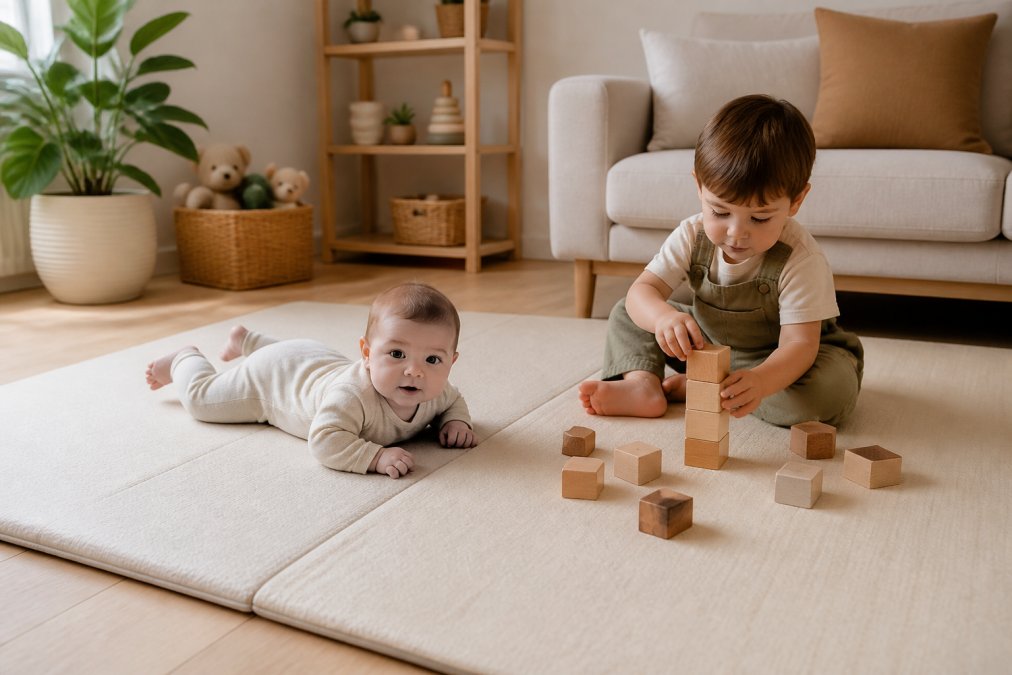
Think about who's using it, too. A newborn needs a soft, easy-clean surface for tummy time. A toddler needs shock absorption. A wheelchair user needs grip and stability, not squish.
TPU vs PVC Playmats Safety: What the Differences Actually Mean
TPU is the safer choice because it doesn't rely on phthalate plasticisers to stay soft, while PVC typically does. That single difference drives most of the safety gap between the two materials.
Here's what that means in practice:
- PVC can off-gas volatile organic compounds for days after unboxing, and the smell lingers in small rooms with poor airflow.
- TPU has minimal odour, wipes clean without degrading, and resists cracking at the folds.
- EVA sits somewhere between the two, and quality depends entirely on the manufacturer's honesty about fillers.
For a child with sensitive skin, the top layer matters as much as the core.
How to Clean Foam Playmats Without Damaging Them
Most foam playmats die from over-cleaning, not under-cleaning. Harsh chemicals break down the top layer and leave it tacky, which then traps more dirt.
- Vacuum or shake off loose crumbs and sand.
- Wipe with a damp microfibre cloth and a drop of mild dish soap.
- Wipe again with clean water to remove residue.
- Air dry fully before the kids jump back on.
- Blot spills immediately rather than scrubbing.
NDIS Registered Playmat Providers: How Funding Works
A registered NDIS provider has been assessed against the NDIS Practice Standards and can supply supports to participants whose plans are managed in a way that requires registered providers.
Eco Friendly Playmats Compared: Prices, Materials and Best Uses
| Product | Price | Material | Best For |
|---|---|---|---|
| The Wanderer | $149.00 | Vegan leather, biodegradable | Beach, park and travel |
| Archer Earth Snuggle Rug | $149.00 | 35D memory foam, 35mm | Tummy time and nurseries |
| Dennis Snuggle Rug | $179.00 | 35D memory foam, 35mm | Living rooms and playrooms |
| Cushy Change Clutch | $69.00 | Recycled vegan leather | Nappy changes on the go |
Pros and Cons at a Glance
The Wanderer

- Pros: waterproof, portable, 100% vegan, biodegradable
- Cons: only 2mm thick, so it's not a cushioned play surface
Archer Earth Snuggle Rug
- Pros: 35mm thick, neutral earth tones, ultra-soft underfoot
- Cons: needs time to flatten after unboxing and may require ironing
Dennis Snuggle Rug
- Pros: highest-density foam available, artist-designed print
- Cons: preorder item, and unwrapped returns can't be accepted
Cushy Change Clutch
- Pros: folds into a clutch, wipe-clean, gift-boxed
- Cons: designed for nappy changes, not full-time floor play
What actually happens at end of life
Most listings say "biodegradable" and stop there. That word is doing a lot of work, and it's worth unpacking because the honest answer depends on the material and on where the mat ends up.
A practical disposal checklist
- Check whether the mat separates into layers. If the cover zips off, you can deal with each part differently.
- Ask the supplier whether they run a take-back or repair scheme before you buy, this is the single most useful question for end of life.
- Check your local council's waste and recycling guidance, because accepted materials vary by council area.
- If it's still structurally sound, pass it on. A mat that's too thin for tummy time is often fine as a picnic mat, a boot liner or a pet mat.
- Only compost a component if you're certain it's a natural fibre and free of plastic backing or synthetic stitching.
Matching the mat to your priorities
If portability and a low environmental footprint at disposal are your priorities, a thin biodegradable mat like The Wanderer is the better fit, provided you accept it isn't a cushioned play surface. If cushioning and daily durability matter more, the 35mm memory foam rugs are the stronger choice, but plan for reuse rather than composting at end of life. If you want the easiest disposal path, look for a mat with a removable organic cotton cover and ask the supplier directly what happens to the foam core.
Common Mistakes When Buying Eco Friendly Playmats
The biggest mistake is buying on price alone. A cheap mat that flattens in six months costs more than one that lasts five years.
Other traps worth avoiding:
- Trusting the word "eco" without a certification body behind it
- Ignoring thickness and density specs, then wondering why the mat feels like cardboard
- Choosing a size that doesn't fit the actual room
- Skipping the care instructions and killing the top layer with bleach
- Assuming every supplier can be claimed through NDIS funding
Frequently Asked Questions
Are TPU playmats safer than PVC options?
TPU foam is generally considered safer than PVC for babies. TPU is free from phthalates, BPA and heavy-metal stabilisers that PVC can contain, and it does not need plasticisers to stay flexible. PVC mats often rely on phthalates to soften the material, which is why many parents avoid them. When comparing TPU vs PVC playmats safety, check that the mat is labelled PVC-free and phthalate-free, and look for Oeko-Tex Standard 100 or similar testing.
How do I clean and maintain an eco-friendly playmat?
Wipe the surface with a damp cloth and a small amount of mild soap, then dry it straight away. Most TPU-coated and vegan leather mats are waterproof, so spills do not soak in. For deeper marks, use a soft cloth rather than a scrubbing brush, which can dull the coating. Avoid bleach, ammonia and abrasive cleaners. Vacuum memory foam rugs on a low setting to lift crumbs, and air the mat outdoors in shade rather than direct sun. Cleaning foam playmats this way keeps the surface soft-touch and stain-resistant for years.
Are there NDIS-approved playmats available?
The NDIS does not approve individual playmats, but it can fund them when they meet a participant's disability-related needs. A cushioned, non-slip mat used for sensory regulation, safe floor play or mobility support may be claimable under core supports or assistive technology, depending on the plan. Buying from NDIS registered playmat providers makes the process simpler because they can supply compliant invoices and work with plan managers. Keep your therapy reports and a clear written reason for the purchase before you submit a claim.
How long should an eco-friendly playmat last, and what does a warranty cover?
A well-made mat should stay flat, soft and intact for several years of daily use. What separates a durable mat from a cheap one is foam density: 35D slow-rebound foam holds its shape far longer than low-density foam that compresses into permanent dents. Warranties normally cover manufacturing faults such as delamination, faulty seams or foam that fails to expand, not general wear, cuts or stains. Check the warranty length and what it excludes before you buy, and keep your proof of purchase.
Buying a playmat that's genuinely safe, genuinely durable and genuinely fits your space takes more than a quick scroll through product photos. Grace & Maggie makes that decision easier with TPU coated memory foam free from BPA and PVC, 35mm high-density cushioning across its Snuggle Rug range, and registered NDIS provider status for families claiming through a funded plan. Shop All and find a mat built to last from tummy time through to school age.