


Can a Baby Playmat Work in a Minimalist Interior?
Last Updated: November 5, 2026
Quick Summary
Choose a baby playmat by matching it to your room's existing palette and floor plan, not to trends. Pick a neutral mid-tone that sits between your floor and wall colours, measure the free floor space, and confirm it leaves a clear walkway before you buy.
- Match colour temperature to your room: warm neutrals for timber floors, cool neutrals for white walls and concrete.
- Keep the palette to three tones and choose a mat in the lightest or mid tone.
- Leave a walkway of at least 600 mm around the mat for adults and older children.
- A newborn needs roughly 1.2 m by 1.2 m of mat space, growing to about 1.8 m by 1.2 m once crawling.
- In childcare rooms, choose a mid-tone neutral with a non-slip base and wipeable surface.
Table of Contents
- Start With Your Room, Not the Playmat
- Which Baby Playmat Materials Suit a Minimalist Home?
-
How to Choose a Neutral Baby Playmat That Blends In
- Step 1: Match colour temperature, not just colour
- Step 2: Read the undertone of your flooring
- Step 3: Choose pattern scale to suit the room
- Step 4: Match texture to your existing materials
- Step 5: Check it in daylight before committing
- Step 6: Keep the palette to three tones
- Adapting the method for childcare and education rooms
- Measuring and Zoning Your Baby Play Area Design
- Why an Easy-Clean Baby Playmat Matters Day to Day
- What Makes a Padded Playmat for Childcare Settings Different
- Checking Safety, Materials and Product Care
- Choosing Your Playmat at Grace & Maggie
- Frequently Asked Questions
Start With Your Room, Not the Playmat
Here's the mistake most parents make: they buy the playmat first, then try to make it fit the room.
The trick is simple. Match the mat to the room's existing palette and floor plan, not to whatever is trending online.
Minimalist design is about restraint. Fewer objects, softer tones, clean lines. A bright primary-coloured mat fights that.
So before you shop, do three things:
- Note your floor tone and wall colour
- Measure the free floor space
- Decide where the mat will live day to day
That groundwork makes every later decision easier.
Which Baby Playmat Materials Suit a Minimalist Home?
A neutral baby playmat usually comes in three materials, and each behaves differently in a minimalist room. The right pick depends on how much cushioning you need and how much upkeep you'll tolerate.
Foam mats offer the most cushioning. Memory foam and high-density foam feel soft underfoot and absorb impact well. They suit tummy time, crawling and floor play.
Fabric playmats look softer and more like a rug. Quilted and padded fabric options blend into living rooms nicely.
Padded TPU mats sit in the middle. A TPU coating gives you a wipeable surface over a padded core.
Foam, fabric and padded TPU compared
| Material | Cushioning | Cleaning | Best for |
|---|---|---|---|
| Memory foam | High | Wipe or spot clean | Tummy time, sensory spaces |
| Quilted fabric | Medium | Machine wash | Living rooms, older babies |
| Padded TPU | High | Wipe clean | High-use play and childcare |
If you want a memory foam option that fits a neutral palette, our Designer Memory Foam Tatami Snuggle Rug shows how a tatami-style rug pairs plush foam with understated design.
How to Choose a Neutral Baby Playmat That Blends In
Picking a neutral mat is about more than grabbing the beige one. You want a tone that sits with your room, not one that fights it or washes out entirely. The most useful approach is a repeatable method that works for both home living rooms and childcare rooms.
Step 1: Match colour temperature, not just colour
Every neutral has a temperature. Warm neutrals, sand, clay, oatmeal, taupe, sit naturally with timber floors, cream walls and rattan or oak furniture.
A simple test: hold a piece of white paper against your wall and floor in daylight. If the paper looks slightly creamy, your room leans warm; if it looks slightly blue-grey, it leans cool.
Step 2: Read the undertone of your flooring
Flooring is the largest surface a playmat sits on, so it sets the undertone. Timber with orange or honey tones pairs well with warm neutrals and soft terracotta accents. Grey-washed timber and polished concrete suit cooler stones and greys. Carpet is often warmer than it appears under artificial light, so check it near a window before you commit.
Step 3: Choose pattern scale to suit the room
Minimalist rooms rely on restraint, so pattern should be subtle and small-scale. A fine herringbone, a low-contrast stripe or a lightly stippled texture adds depth without becoming the focal point. Large, bold patterns fight minimalist lines and make a small room feel busier. If you want pattern, keep it tonal, within the same colour family.
Step 4: Match texture to your existing materials
Texture is where minimalist interiors gain warmth. If your room is heavy on smooth surfaces, painted walls, glass, polished floors, a mat with a soft pile, quilted surface or woven-look finish adds balance. Balancing texture rather than adding colour keeps the mat in step with the wider room, a principle that carries through a modern minimalist home.
Step 5: Check it in daylight before committing
Artificial light shifts colour. A mat that looks soft grey in a showroom can look lilac under warm globes, or flat under cool LEDs. View a sample or the mat itself in natural daylight, ideally near the window where it will live. If you are buying online, ask for a fabric or colour swatch, or check the returns policy so you can assess it in your own room.
Step 6: Keep the palette to three tones
A reliable minimalist rule is to pull three colours from the room, usually a dominant wall tone, a mid floor tone and one accent, and choose a mat that matches the lightest or mid tone. This keeps the mat reading as part of the architecture rather than as an added object. If grey is your base, our grey baby play mat range offers soft, tonal options. Round shapes also soften boxy rooms, so our round baby playmats are worth considering for minimalist spaces.
Watch out: a mat that is too dark draws the eye and makes a room feel smaller, while a mat that is too light can look clinical. Aim for a mid-tone that sits between your floor and your walls.
Adapting the method for childcare and education rooms
In early learning and childcare settings, the same principles apply but the stakes are different. Rooms often have bright primary-coloured resources, so a neutral mat becomes a visual anchor that calms the space. Choose a mid-tone neutral that hides everyday marks, and favour low-contrast textures over busy patterns so the mat does not compete with wall displays and equipment.
Measuring and Zoning Your Baby Play Area Design
Good baby play area design starts with a tape measure, not a product page. A mat that is too big crowds the room and blocks walkways. One that is too small leaves your baby rolling onto hard floor within minutes. The goal is a mat that fits the free floor space, preserves circulation, and creates a clear visual play zone.
How to measure the free floor space
Start by clearing the area where the mat will live. Measure the longest unobstructed rectangle or circle, not the total room size. Then subtract for furniture: a sofa, coffee table or shelving unit all reduce usable floor.
A useful rule of thumb is that the mat should cover the area where your baby will actually roll, sit and crawl, typically a space at least 1.2 m by 1.2 m for a newborn, growing to around 1.8 m by 1.2 m or more once crawling begins. Our size guide helps you match the right memory foam rug to your zone.
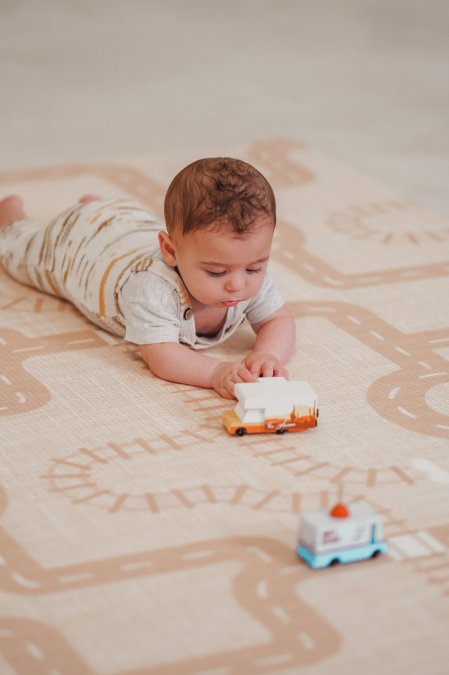
How to zone the play area without cluttering the room
A playmat acts as a visual boundary. It tells everyone, including your toddler, where play happens, and it keeps toys from spreading across the whole room. In a minimalist space, the mat itself is the zone, you do not need extra furniture or storage to define it.
Place the mat against a wall or beside a sofa rather than in the centre of the room. This anchors it visually and leaves the rest of the floor open.
Zoning in childcare and education settings
In childcare and early learning rooms, zoning is about supervision and flow. Place padded mats in defined activity areas rather than across walkways. Leave clear paths between zones so educators can move quickly and children can move safely.
Watch out: buying before you measure is the fastest way to end up with a mat that looks out of place or blocks a doorway.
Why an Easy-Clean Baby Playmat Matters Day to Day
An easy-clean baby playmat saves you time every single day. Spills, scuffs and dribble are part of floor play.
This matters more in minimalist homes. Clutter and mess stand out. A mat that wipes clean keeps the calm look intact.
Wipeable surfaces like TPU handle everyday mess well. Fabric mats need machine washing, which is fine but slower. Foam needs spot cleaning and a little care around seams.
A few practical habits help:
- Wipe spills straight away
- Keep a cloth near the play zone
- Rotate the mat to spread wear
- Vacuum or sweep underneath weekly
What Makes a Padded Playmat for Childcare Settings Different
A padded playmat for childcare has to survive far more than a home mat.
Durability comes first. High-density foam and sealed surfaces hold up better under constant foot traffic and repeated wiping.
Safety matters just as much. Non-slip backing keeps mats in place when children run and tumble.
Cleaning speed is the third factor.
We design our products with these settings in mind.
Checking Safety, Materials and Product Care
Safety checks should come before style. Ask what a mat is made from and how it's tested.
Look for these signals:
- Foam certified free from harsh chemicals
- Fabric tested for safety, such as OEKO-TEX STANDARD 100 (OEKO-TEX® STANDARD 100)
- Clear care instructions from the maker
- A non-slip base
- Honest details about materials
Care is straightforward. Wipe spills, spot clean where needed, and let foam air out. Vacuum the surface regularly to lift dust and crumbs.
Watch out: unsealed foam can stain if spills sit. If safety and easy care top your list, our tummy time mats are vetted for exactly that.
Choosing Your Playmat at Grace & Maggie
You now have a clear path.
At Grace & Maggie, we make products for homes and childcare settings alike. Our range includes Padded Playmats, Memory Foam Snuggle Rugs and the Cove Sensory Lounger.
Style, safety and practicality can live together. A well-chosen mat keeps your minimalist room calm and gives your child a soft, safe place to play.
Frequently Asked Questions
What colour baby playmat works best with neutral interiors?
Warm neutrals are the safest choice: stone, sand, clay, taupe, sage and soft grey all sit comfortably against cream walls and light timber. Look for a mat with a subtle pattern rather than a flat block of colour, because a low-contrast print hides scuffs and spills between cleans. If you want a little life in the room, a muted pastel or a soft green adds interest without competing with your furniture. Avoid anything with high-contrast cartoon prints if the goal is for the mat to blend into the space.
How do I clean and maintain a padded playmat?
Most day-to-day mess comes off with a damp cloth and a mild soap, so wipe spills promptly rather than letting them sit. For a memory foam snuggle rug, vacuum gently on a low setting and spot clean rather than soaking the surface. Check the care label before using any product, and avoid harsh solvents that can break down the coating. Rotating the mat occasionally helps it wear evenly, and airing it out keeps it fresh in humid weather.
What size playmat suits a baby play area?
Measure the clear floor space first, then leave a walking gap of roughly 60cm on the sides you use most. A mat that fills the whole zone looks intentional; one that leaves awkward slivers of floor looks like clutter. For a small apartment, a single generously sized mat often works better than several small foam tiles, because there are fewer edges to trip on and fewer seams to collect crumbs. Mark the footprint with tape before you buy.
Are padded playmats suitable for early learning environments?
Yes, provided the mat is built for high use. In a childcare or early learning room, look for a dense foam that recovers its shape, a wipeable surface that stands up to daily cleaning, and a non-slip base so it stays put during active play. A padded playmat for childcare also needs to cope with group activities, reading corners and quiet time, so thickness and edge durability matter more than in a home setting.
Ready to build a play space that looks as good as it feels? Get started with Grace & Maggie and find a playmat that fits your home, your childcare room and your everyday life.
